
The Loom of the Rising Sun in Arunachal Pradesh : From Apatani to Monpa Weaves | Vunavya
Read this in – বাংলা/हिन्दी/असमिया
Located on the north-eastern frontier of India, Arunachal Pradesh is fondly called the ‘Land of the Rising Sun’. Cradled by majestic mountains and dense forests, this state is home to a rich tapestry of indigenous tribes. The absolute centerpiece of their culture is the historic art of loin-loom (backstrap) weaving. Today, on this exclusive master blog by Vunavya, we dive deep into the history, motifs, and mechanics of the 4 most iconic textile traditions of Arunachal Pradesh— Apatani Weaves, Adi Gale, Mishmi Textiles, and Monpa Weaves.
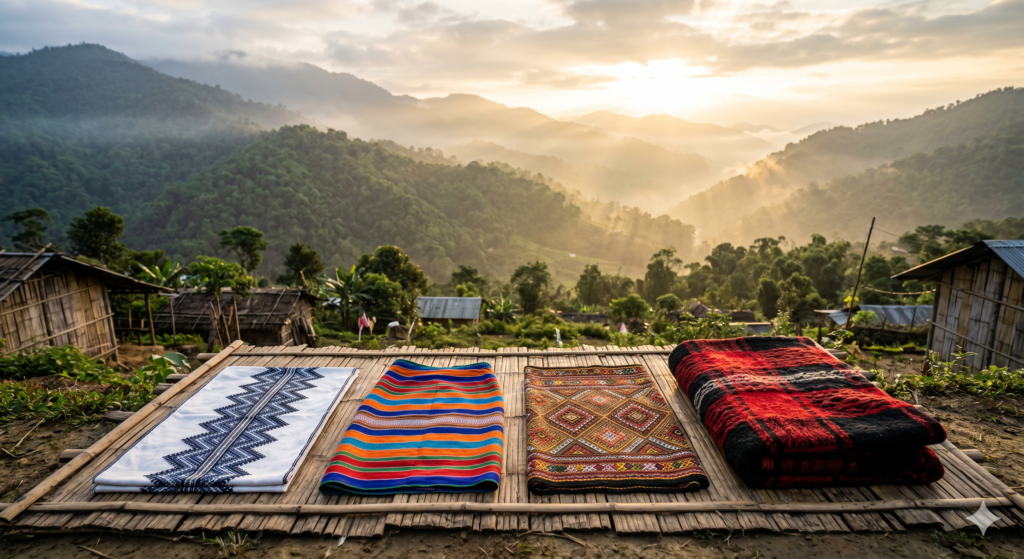
1: Apatani Weaves — The Magic of Geometric & Zigzag Lines
Hailing from the picturesque, UNESCO-contended Ziro Valley in the Lower Subansiri district, the Apatani tribe is highly revered for its calculated, nature-integrated lifestyle and spectacular weaving style.
- Historical and Social Context: In Apatani society, weaving is far more than a basic domestic chore; it is an intrinsic measure of a woman’s artistic stature and social dignity. Mothers pass down this ancestral knowledge to their daughters at a very tender age. By custom, wearing these self-woven traditional garments during major community festivals like Myoko and Dree is a mandatory pride.
- Weave Density and Motifs: The defining visual signature of Apatani handlooms is the flawless, razor-sharp integration of broad horizontal bars and complex, miniature zigzag motifs, locally referred to as the ‘Pree’ pattern. The master weavers count every single warp and weft thread precisely so that the elaborate geometric patterns appear identically flawless on both sides of the woven fabric.
- Color Palette and Attire: Dominated heavily by bold combinations of scarlet red, deep indigo, pitch black, and pristine organic white threads, the Apatanis produce stunning ceremonial shawls like the ‘Tareh Polo’ and intricately patterned male jackets known as ‘Zigjir’. The sheer thread density makes these garments extraordinarily warm and lifelong assets.
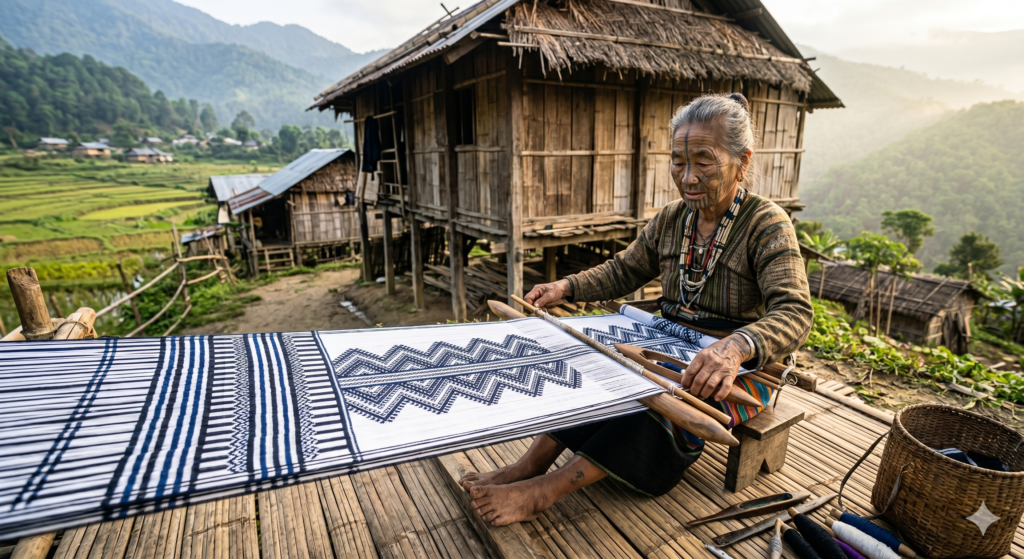
2: Adi Gale — The Woven Crest of Clan Identity
The ‘Adi’ tribe represents one of the most populous indigenous groups in Arunachal Pradesh, majorly inhabiting the lush valleys of the Siang and Lohit rivers. The ultimate crown jewel of Adi weaving is the traditional attire worn by their women, known as the ‘Gale’—a heavy-duty, meticulously structured wrap-around skirt.
- Sociological Anchor and Clan Marking: In Adi folklore, a Gale is not just apparel; it functions as an indisputable visual record of a woman’s clan identity and social status. The specific configurations, spacing, and thread count of the broad black or colored bands running across the absolute center of the cloth explicitly reveal which ancestral clan the wearer belongs to. Furthermore, there are subtle structural design variations that differentiate the Gale worn by an unmarried girl from that of a married woman.
- The Loom Mechanics: Woven entirely out of pure, high-quality cotton yarn on traditional loin looms, the fabric is bound tightly by stretching the warp threads using the weaver’s own body weight. This process makes the textile wind and water-resistant—a vital functional requirement that shields Adi women from harsh mountain downpours and humid weather during intensive agricultural field works.
- Modern Fashion Renaissance: Honoring this grand heritage, contemporary slow-fashion designers are now actively integrating the classic Adi Gale stripe layouts into modern kurtis, western skirts, and fusion evening gowns, capturing global fashion accolades.
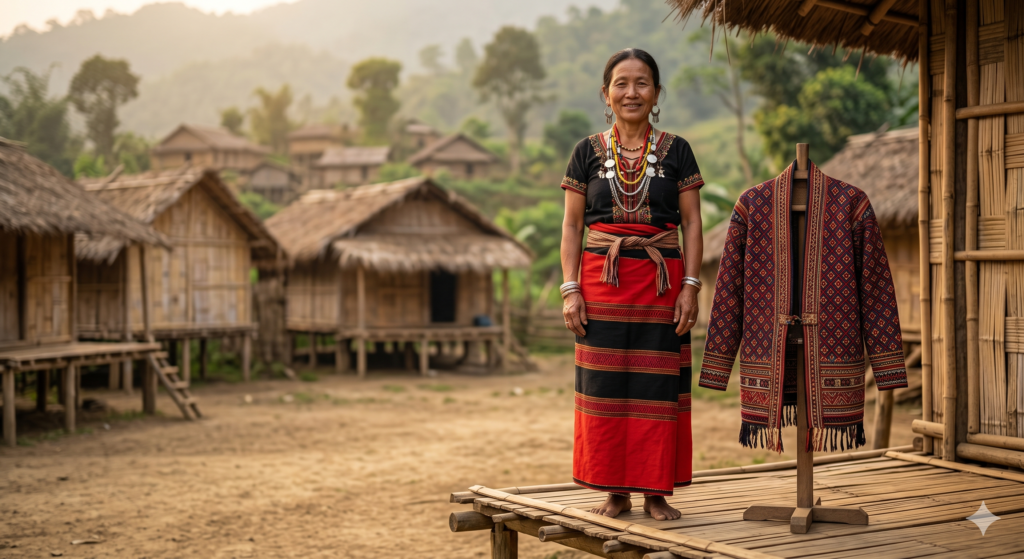
3: Mishmi Textiles — Nature-Inspired High-Fidelity Weaves
The Mishmi weavers (comprising the Idu, Digaru, and Miju Mishmi sub-tribes) are universally acknowledged as the master couturiers of the Arunachal hills. Their legendary command over fabric ornamentation and sophisticated color palettes is unmatched in the northeastern frontiers.
- Organic Alchemy from Nature’s Laboratory: The primary allure of Mishmi handlooms lies in the absolute purity of their colors. Rejecting synthetic chemical formulations completely, Mishmi women extract pure, rich organic dyes by boiling local forest barks, wild roots, leaves, and mountain herbs. Yarn processed through this ancient botanical method retains its vivid coloration and structural gloss for decades without fading.
- Intricate Motifs and Geometrical Brilliance: Mishmi coats, shawls, and skirts feature highly complex, miniature Diamond-Shaped (diamond grid) patterns and sharp triangular geometric blocks. The work is so remarkably precise that from a distance, it appears to be executed on high-tech computerized industrial looms. In reality, it is achieved completely via a simple bamboo-and-wood backstrap loom, guided solely by the weaver’s calculated finger insertions.
- Cultural Symbolism: The meticulously detailed jackets woven for Mishmi men frequently feature symbolic arrangements that represent bravery, ancient protective talismans, and war folklore, preserving the oral history of the tribe within the threads.
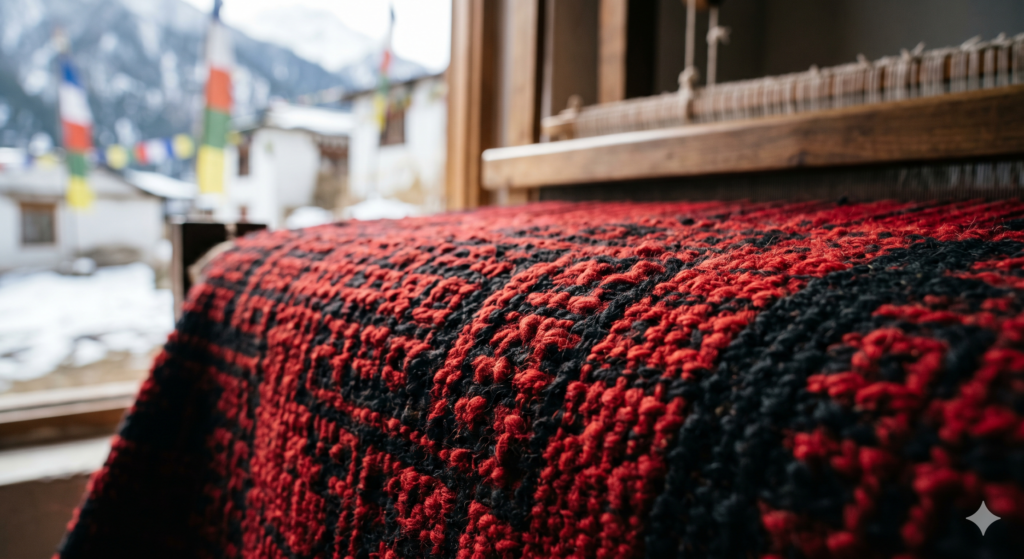
4: Monpa Weaves — Traditional Woollen Warmth from the High Altitudes
Residing in the sub-zero high altitudes of Tawang and West Kameng districts along the international borders, the Monpa community practices a peaceful lifestyle deeply rooted in Mahayana Buddhism. To conquer the unforgiving Himalayan winters, their textile tradition evolved around heavy wool processing.
- The Tibetan Buddhism Influence: Monpa textiles demonstrate a deep, spiritual convergence with ancient Tibetan weaving philosophies. Apart from standard clothing, they are highly celebrated for hand-knotting thick woollen carpets and heavy winter gear that feature motifs directly inspired by monastery wall art.
- Raw Materials and Hand-Knotted Mechanics: Monpa women harvest raw wool directly from local mountain sheep and yaks. This wool is meticulously carded and hand-spun into thick yarn using traditional drop spindles (Charkha). Blending this coarse wool with organic cotton, they weave heavy drapes and a iconic, buttonless, knee-length traditional wool coat known as the ‘Shingka’.
- Sacred Monastic Color Schemes: Monpa textiles are prominently dominated by rich madder red, deep black, and dark monastic yellow. They often weave sacred symbolic geometries into the fabrics, representing clouds, lotus flowers, and cosmic wheels, bringing a bright, spiritual warmth against the stark white snowscapes of Tawang.
Conclusion
The tribal handlooms of Arunachal Pradesh demonstrate how fashion can co-exist organically with nature for hundreds of years. From the razor-sharp geometry of the Apatanis to the warm woollen loops of the Monpas, every thread narrates a story of survival, identity, and art. Bridging the gap between these mountain looms and global textile connoisseurs, Vunavya stands proud in keeping this heritage alive.