The ultimate guide to Lucknowi Jamdani. Discover the rich history, Tantu extra-weft weaving mechanics, and practical tips to identify authentic handloom luxury.
Read this in – বাংলা/हिन्दी/मैथिली
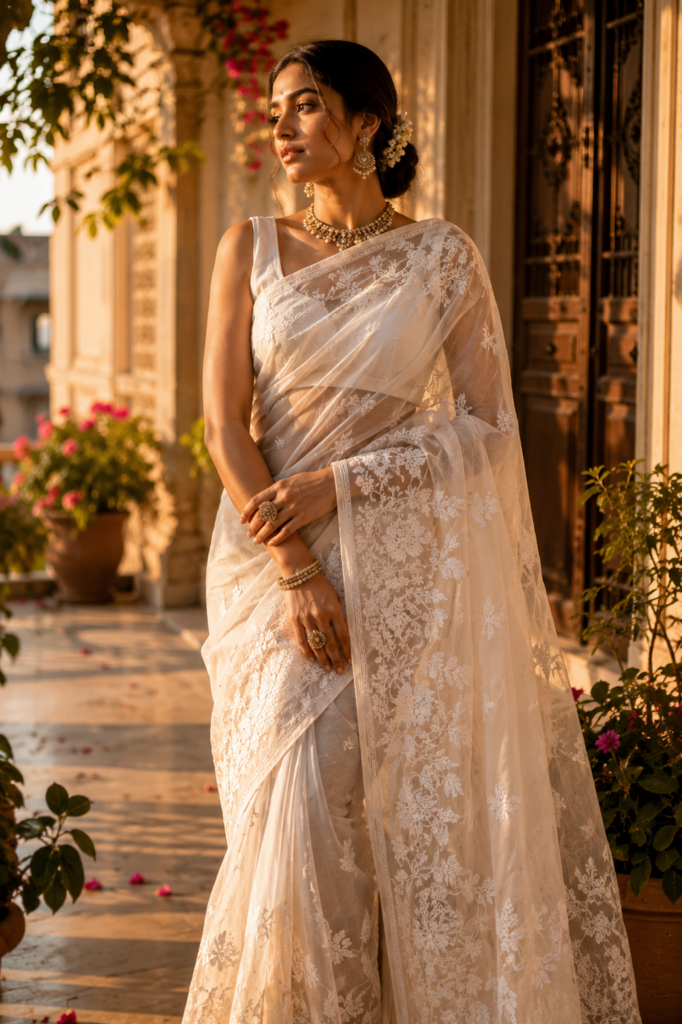
The historic looms of Uttar Pradesh hold an extraordinarily prestigious place in global textile history as a sanctuary for ultra-fine cotton weaving. Beyond the heavy opulence of Banarasi silks, the region preserves an exceptionally rare, feather-light textile art celebrated as Lucknowi Jamdani, locally known as the Tantu weave. Every single motif interlaced on transparent muslin carries a magnificent reflection of Awadh’s courtly elegance and mathematical precision. Today, on this comprehensive blog by Vunavya, we explore the fascinating history, intricate material specifications, and provide practical answers to some highly essential questions regarding the Lucknowi Jamdani Saree.
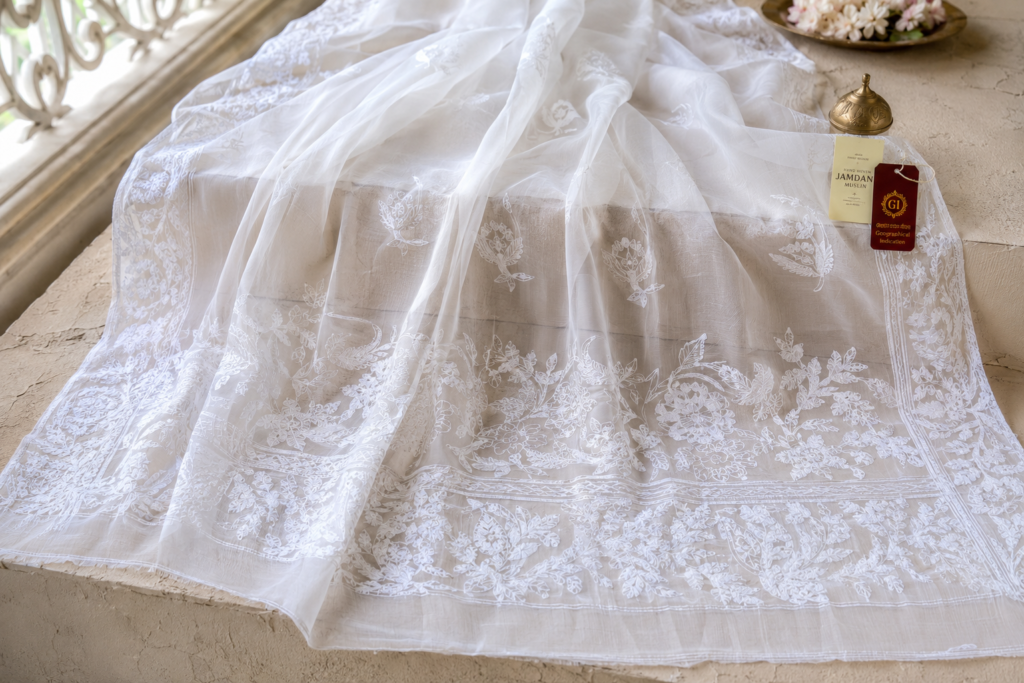
1: The Technical Mechanics of Jamdani Weaving — The Power of Tantu
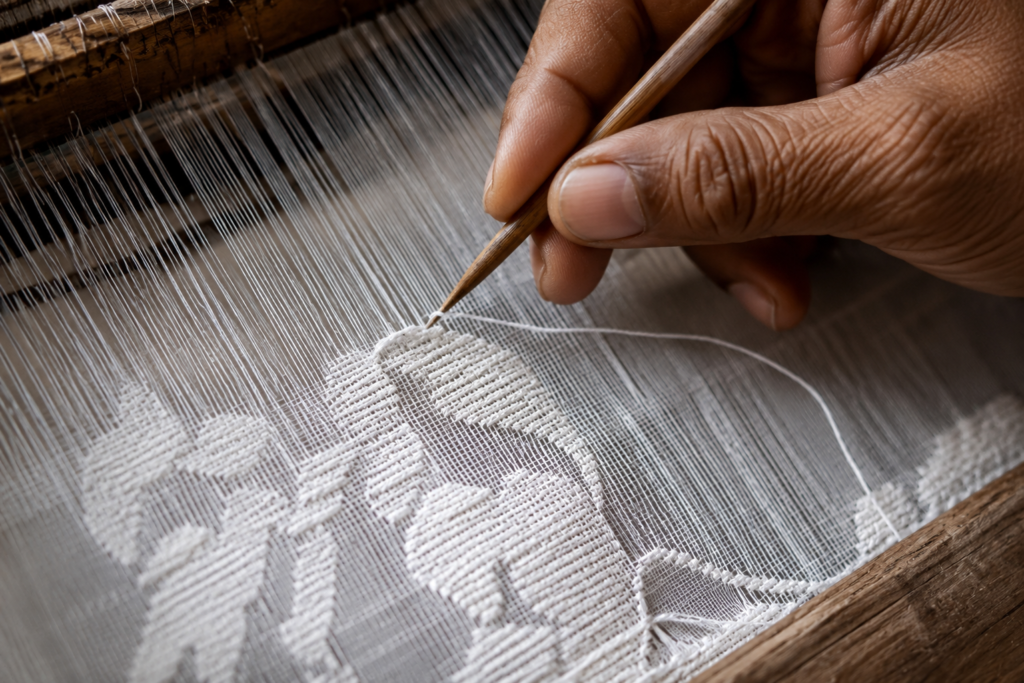
The primary allure of Lucknowi Jamdani lies heavily within its supplementary extra-weft insertion technique and the usage of extreme 100 to 200-count fine muslin bases.
- The Tantu Insertion Mechanism: While weaving the primary sheer base on the pit-loom, artisans strictly deploy specialized needle-like bamboo or wooden splints. Using these delicate tools, weavers manually interlock supplementary un-twisted cotton or floss silk threads (Extra Weft) directly into the warp. Consequently, this intricate mechanism explicitly embeds the motifs flush into the fabric matrix, making the patterns appear like an organic shadow or watermark.
- The Traditional Geographical Hub: The definitive historical hub for this fine execution spans the rural weaving corridors between Varanasi and Lucknow. Here, master weavers work entirely by optical intuition without any graphic cards or mechanical stencils. Today, protected strictly by its official GI Tag (Geographical Indication) framework, this zero-carbon heritage fabric remains a prized possession across global slow-fashion circles.
2: Traditional Geographical Hub and Contemporary Sustainable Luxury
The true magicians of this century-old weaving craft are the rural weavers of Uttar Pradesh, who have meticulously preserved this complex geometric calculus across generations.
- The Varanasi-Lucknow Border Hub: The definitive historical and geographical epicenter for authentic Lucknowi Jamdani spans the rural weaving corridors located between Varanasi and Lucknow. Here, master weavers work on traditional pit-looms entirely by optical intuition, drafting imperial sarees without the aid of any graph paper or mechanical stencils. The official GI Tag (Geographical Indication) framework explicitly protects and certifies its pristine purity on the global platform.
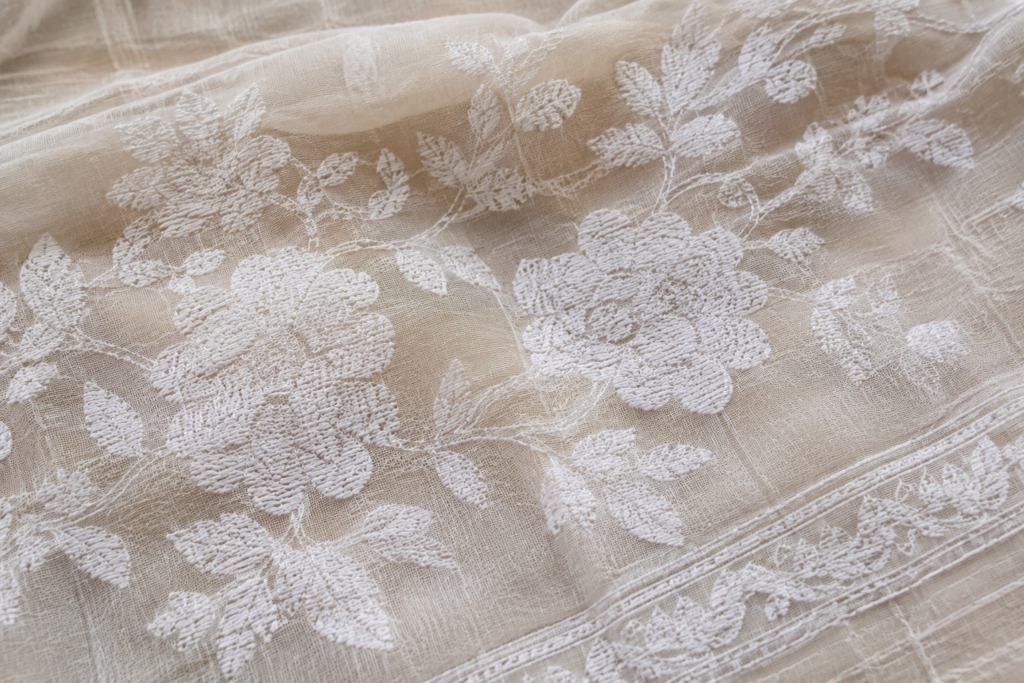
- Modern Silhouette Adaptations: Respecting this magnificent heritage, contemporary luxury fashion designers actively integrate these sheer Jamdani panels into high-end summer tunics, pastel sarees, and premium un-dyed dupattas. Consequently, this unique blend of historic artistry and zero-carbon footprints has made it highly coveted across international slow-fashion markets.
3: Frequently Asked Questions (FAQ)
Q1: What is the most reliable method to identify an authentic hand-woven Lucknowi Jamdani saree?
Answer: An authentic handloom Jamdani saree is explicitly reversible, showing identical structural neatness, color intensity, and absolute flatness on both the front and reverse sides with no loose thread floats. Powerloom imitations feature an explicit mesh of cut thread floats on the back.
Q2: What is the primary distinction between a Lucknowi Jamdani and a traditional Dhakai Jamdani?
Answer: Dhakai Jamdani is characterized by dense, highly geometric configurations rendered in vivid colors or gold metallic zari. Conversely, Lucknowi Jamdani strictly utilizes a minimalist ‘White-on-White’ or muted pastel thread layout over fine translucent muslin, creating a highly scattered aesthetic.
Q3: What is the recommended care and maintenance routine for a fine Jamdani saree?
Answer: Because it features exceptionally fine high-count cotton yarns, you should strictly hand wash the garment at home using mild liquid soap and cold water, or dry clean it. When storing, periodically shift and change its fold lines every few months to prevent the fibers from breaking under continuous crease pressure.
Conclusion
The sheer drapes of Lucknow demonstrate how fashion can co-exist organically with human precision and absolute lightness for hundreds of years. From the hidden whispers of the Tantu weave to the minimalist white-on-white bootis, every single panel narrates a story of sustainability and identity. Bridging the gap between these rural master weavers and global textile lovers, Vunavya stands proud in keeping this heritage alive.