
The complete guide to Haryana’s Panipat Panja Dhurrie and Tilla craft. Discover heavy claw-beater weaving mechanics, durable cotton fibers, and price guide.
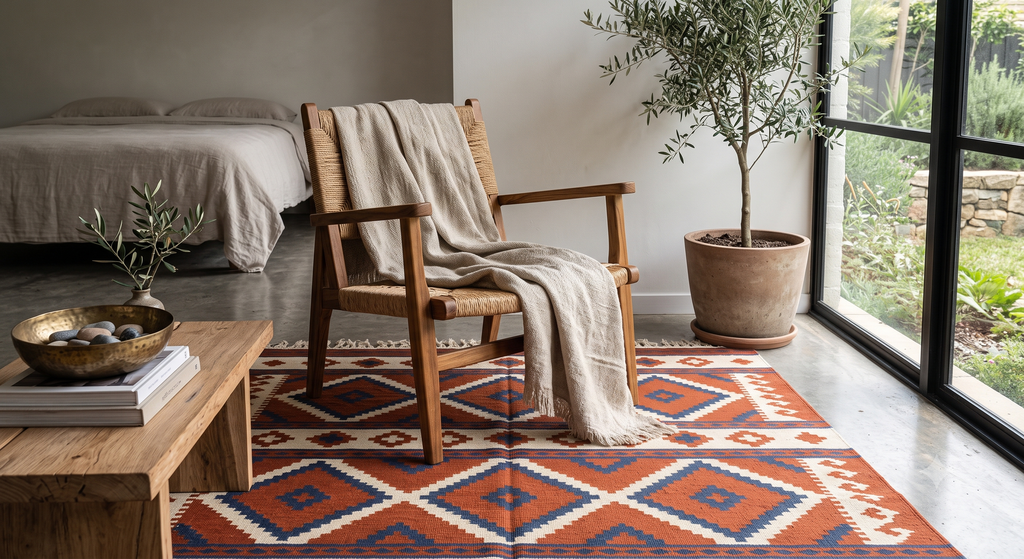
Beyond utilitarian bedcovers and historical battlefields, the textile hub of Panipat in Haryana commands global authority for its architectural floor coverings. The undisputed champion of this rugged aesthetic is the Panipat Panja Dhurrie—a flat-woven, reversible rug engineered for extreme structural durability. Complementing this heavy weaving heritage is Haryana’s rural Tilla Craft, an intricate embroidery technique executing ornate metallic wire patterns on traditional footwear (juttis) and festive wear. Today, Vunavya unpacks the beating mechanics of the iron panja, metallic embroidery dynamics, labor investments, and authentic pricing.
1: Material Specifications & Panja Weaving Mechanics
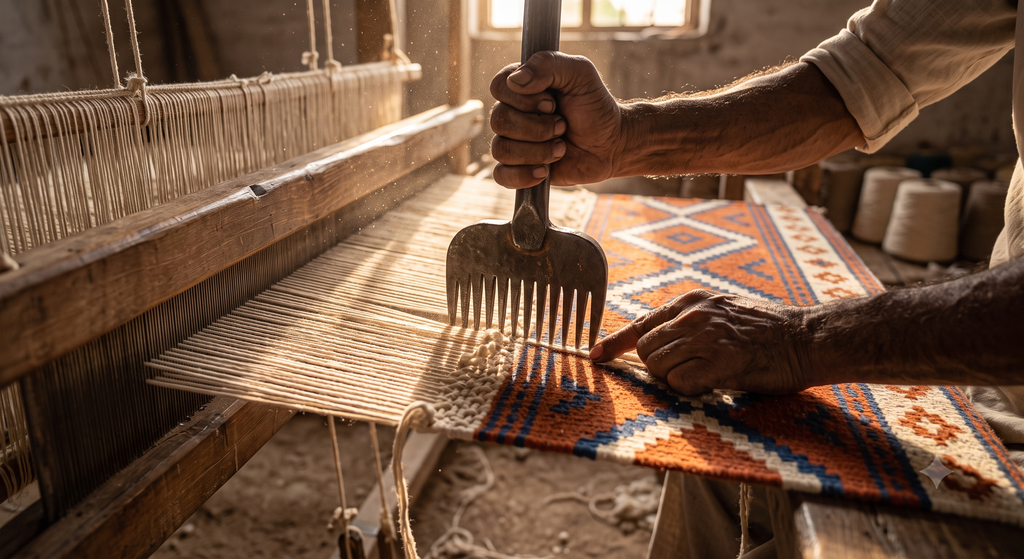
The sheer strength and visual density of a Panja Dhurrie stem from specialized weft compression using an indigenous hand tool.
- The Panja Tool & Weft-Faced Weave: Weavers construct the rug on vertical or horizontal pit-looms using a heavy metallic claw-like beater known as a ‘Panja’. Weighing over one kilogram, this iron comb is manually driven down onto the newly inserted weft picks. This intense compaction forces the weft threads to completely conceal the warp, producing an impenetrable ‘weft-faced flat weave’.
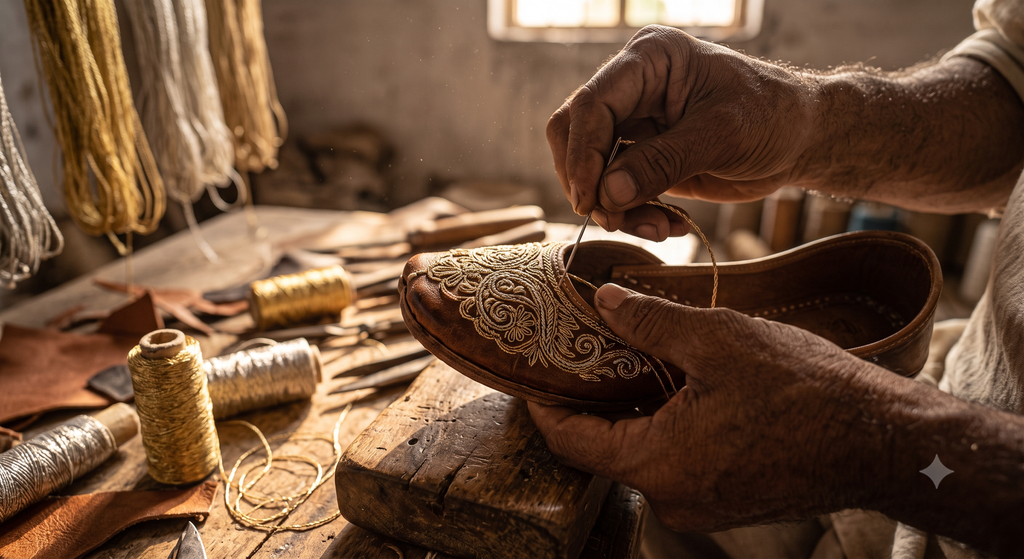
- Yarn Grades and Tilla Wire Mechanics: The rug employs high-twist 3/10s or 6/10s coarse organic cotton yarns, often blended with locally sourced rough sheep wool for pile integrity. Concurrently, Haryanvi Tilla work utilizes flattened metallic ribbons, silver-gilded copper threads, or zari cords hand-stitched onto dense suede, leather, or velvet substrates.
2: Weaving Duration and Practical Price Range Guide
A genuine Panipat Panja Dhurrie demands intensive muscular output and continuous mathematical alignment.
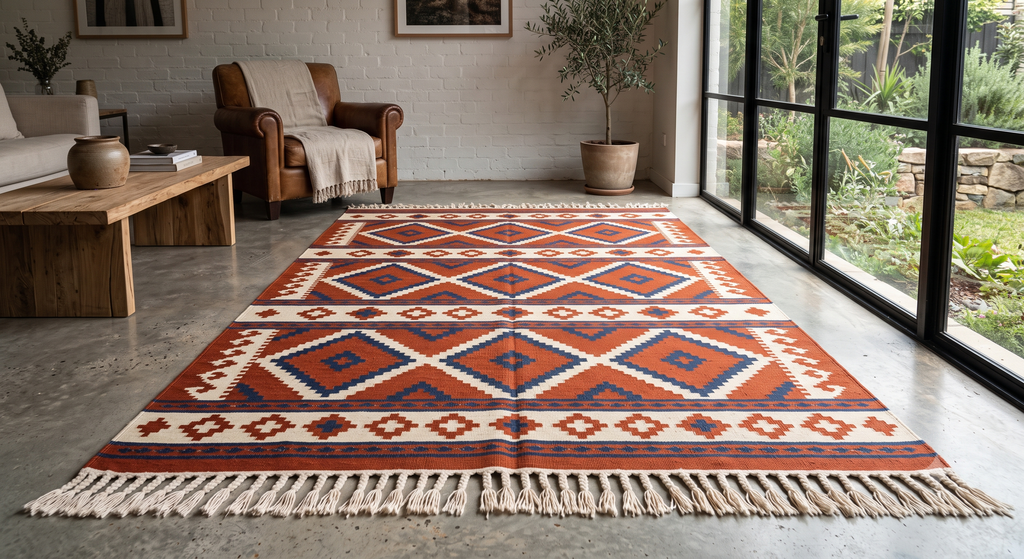
- Artisanal Labor and Time: Sorting yarn, setting the warp, and executing geometric Kilim-style color interlocks on a standard 6×4 foot Panja rug takes 10 to 15 days of steady work by two master artisans. Hand-crafting a pair of fine metallic Tilla juttis requires 3 to 5 days.
- Price Range and Budget Guide: Authentic 100% cotton Panipat Panja Dhurries range from ₹2,500 to ₹7,500. Wool-blended, oversized geometric collector rugs command between ₹8,000 and ₹18,000+. Authentic handcrafted Tilla juttis retail between ₹1,200 and ₹3,500.
3: Geographical Epicenters and Contemporary Sustainable Utility
This craftsmanship remains deeply rooted across Haryana’s historic artisan belts.
- Panipat and Rural Outskirts: The urban cluster of Old Panipat, along with surrounding rural belts in Karnal and Rohtak, forms the primary manufacturing sanctuary for authentic Panja rugs.
- Modern Interior Architecture: Contemporary interior designers increasingly specify Panipat Panja Dhurries for modern minimalist, Scandinavian, and rustic farmhouse spaces due to their clean geometric lines and zero-plastic biodegradability.
4: Frequently Asked Questions (FAQ)
Q1: How does a Panja Dhurrie differ from a tufted carpet?
Answer: Tufted carpets feature cut upright wool piles held together by synthetic latex backings. A Panja Dhurrie is an entirely flat-woven textile without pile or synthetic glue, making it 100% reversible and washable.
Q2: How do you identify a genuine hand-woven Panja Dhurrie?
Answer: A genuine handloom Panja Dhurrie has significant weight, a tight knot structure where the warp threads are completely invisible, and hand-braided fringe tassels along the borders.
Q3: What is the optimal care routine for Panja Dhurries?
Answer: Regularly vacuum both sides on a low-suction setting. For liquid spills, spot-clean using mild detergent and lukewarm water. Avoid machine washing heavy rugs to preserve yarn tension.
5: Conclusion
The Panipat Panja Dhurrie and Tilla embroidery encapsulate the unwavering endurance of Haryana’s rural artisan guilds. Where rhythmic iron beats meet organic cotton fibers, rugs of multi-generational resilience are born. By bringing these authentic artisan-made floor coverings directly to modern homes, Vunavya proudly sustains the timeless vitality of Indian handlooms.