
An invaluable golden wonder of Assam’s textile industry – Muga Silk
Read this in- অসমীয়া/हिन्दी /বাংলা
Coming from the Brahmaputra Valley of the northeastern Indian state of Assam, ‘Muga Silk’ is not just a fabric; it is a heritage. Muga silk is known as the king of all silks, and the current price of this silk is around ₹40,000 – ₹50,000 per kg. This special type of silk is not found anywhere else in the world. Due to its brilliant golden hue and extreme durability, it is called the ‘Golden Fiber’. Generally, a pure Muga silk saree remains intact for more than 100 years.
Why is Muga Silk Unique?
The beauty of Muga silk is not just on the outside; its benefits are also proven in medical science. It is extremely comfortable for the skin and is the best clothing for those suffering from skin conditions like eczema or allergies. Besides, this natural fiber protects our skin from the sun’s harmful ultraviolet (UV) rays. In today’s world of Sustainable Fashion, it is 100% biodegradable and eco-friendly.
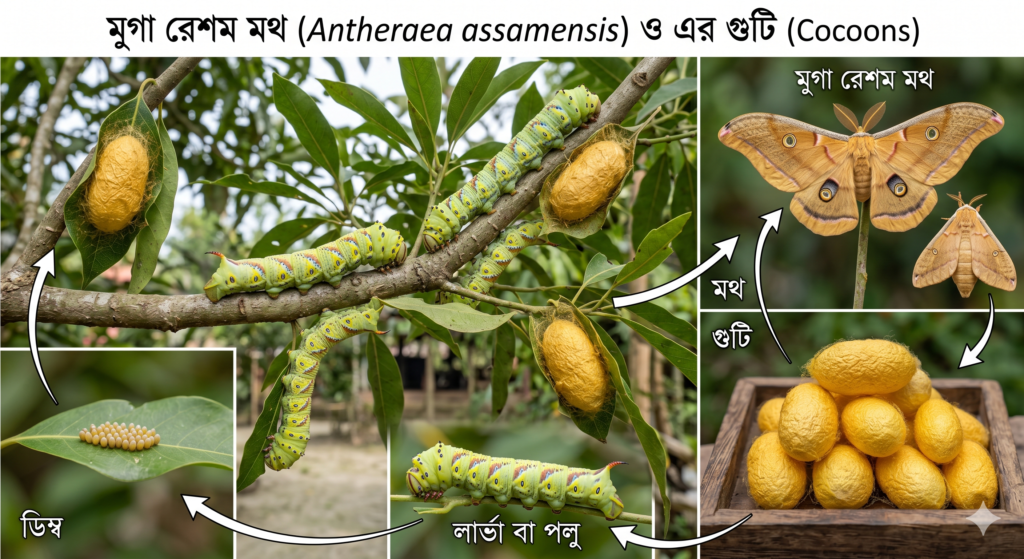
Unique Characteristics of Muga Silk
1.Natural Golden Color: The specialty of this silk is its color. It is not dyed artificially; this golden hue is naturally obtained from the silkworm itself.
2. Durability: It is said that a Muga saree outlives its owner. Its luster does not diminish over time; rather, it increases with every wash.
3. Symbol of Royalty: In ancient times, the kings of the Ahom dynasty of Assam used this silk. Even today, it is a symbol of nobility and culture.
Origin and Weaving Process
Muga silk is produced from a special species of silkworm called Antheraea assamensis. These worms primarily feed and grow on the leaves of ‘Som’ and ‘Sualu’ trees. This silk can only be produced during three months of the entire year. Weavers patiently collect the golden threads from these cocoons and weave stunning sarees and Mekhela Chadors on handlooms. In authentic Muga sarees, ‘Eri’ threads are usually used to weave the motifs. When traditional Assamese motifs like ‘Kingkhap’ and ‘Parboti’ bloom on the saree’s base with white Eri threads and colorful Meenakari work, it takes on an exquisite appearance. In the olden days, Muga sarees were heavily starched, but in the modern era, we use a light starch so that the saree drapes beautifully on the body.
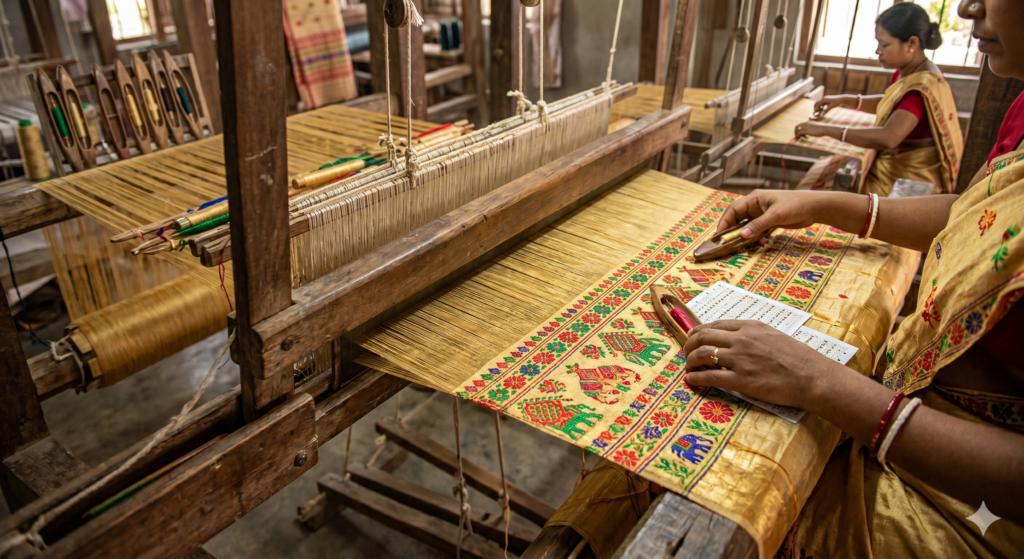
Muga Silk Sarees and Motifs
Nature-inspired motifs are typically seen on sarees and Mekhela Chadors made of Muga silk. Patterns of Japi (Assamese hat), Dhol, Pepa (hornpipe), flowers, and vines make these sarees unique. Nowadays, along with sarees, kurtas, jackets, and modern outfits are also being made from Muga silk.
1.Silk Reeling
After extracting the thread from the cocoons, it is cleaned. Up to 1000 meters of thread can be obtained from a single cocoon. The natural golden glow of Muga silk is so brilliant that it usually does not require any artificial dyes. However, before weaving, the threads are stiffened with starch to make weaving on the handloom easier.
2.Handloom Setup
Muga sarees are usually woven on a ‘Throw-shuttle’ or ‘Fly-shuttle’ pit loom or frame loom.
Warp: Setting up the longitudinal threads of the saree.
Weft: Passing the threads horizontally.
3.Traditional Motifs Technique
Two main methods are used to weave motifs on Muga sarees:
Jacquard Mechanism: Jacquard cards are used in modern handlooms. Here, through punched cards, the weaver determines which thread will be lifted where, bringing complex designs to life.
Extra Weft Technique: This is the real magic of the handloom. While weaving the main base of the saree, motifs are hand-woven using a needle or a small shuttle with different colored threads (usually red, black, or green) or gold/silver zari. In the local language, this is called ‘Phul Bacha’.
4.Popular Designs
The impressions of Assam’s nature and culture are clearly visible in the designs of Muga sarees:
Miri Design: Geometric patterns.
Kaziranga Motif: Designs of elephants, deer, or birds.
Flowers and Vines: Especially ‘Gorgor’ or small butis.
Japi and Dhol: As symbols of Assamese culture, these motifs are also seen on the borders or the pallu.
5.Weaving Process
A skilled weaver can only weave a few inches of a Muga saree per day. Depending on the complexity of the design, it can take anywhere from 10 to 30 days or more to complete a full Muga saree.
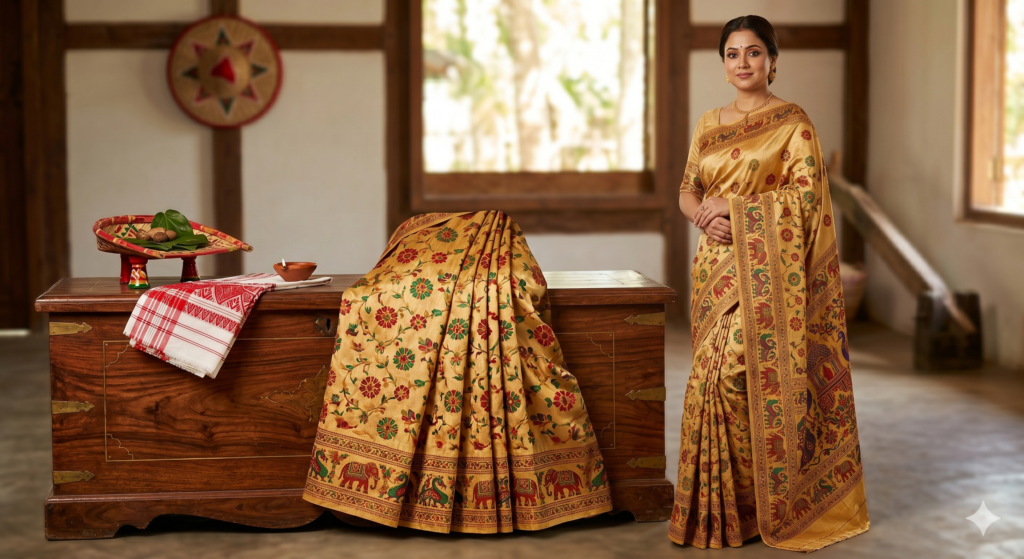
How to Identify
*Brilliant Golden Color: The natural color of Muga silk is golden. It is not an artificial dye. Its shine does not fade after washing or over time; instead, it becomes more luminous.
*Burn Test: Extract a thread from the corner of the saree and burn it. When pure silk burns, it will smell like burning human hair, and the residue will be like black ash (which will crumble into powder when pressed with fingers). If it smells like burning plastic or forms a hard lump, understand that it is a mixed or synthetic silk.
*Touch and Feel: Muga silk generally has a slightly coarse or grainy texture, but it is very comfortable to wear. It is not overly slippery.
*Silk Mark: When buying, always look for the Government of India’s ‘Silk Mark’ logo. It guarantees authentic pure silk.
*Weaving Irregularities: Since it is made on a handloom, if you look very closely, you might notice slight unevenness or tiny knots in the weave, which are absent in machine-made fabrics.
Maintenance and Care Instructions
Muga silk can last for over a century if properly cared for:
*Washing: Dry cleaning for the first few times is highly recommended. If you wish to wash it at home, use mildly cold water and a very gentle baby shampoo or Reetha (soapnut). Never scrub with harsh detergents. Do not wring the water out after washing. Instead, wrap it in a towel to absorb the excess water and let it dry in a shaded area.
*Ironing: Do not apply a very hot iron directly to the fabric. Iron it on low heat from the reverse side while the fabric is still slightly damp. The best way is to place a thin cotton cloth on top and iron over it.
*Storage: Do not store Muga sarees in plastic packets; this damages the silk fibers. Always wrap them in white cotton or muslin cloth. Occasionally (every 3-4 months), take it out of the wardrobe, air it in the shade, and change the folds. Keeping it in the same fold for a long time can cause permanent crease marks.
*Perfume and Naphthalene: Do not spray perfume directly on the saree, as it can ruin the silk’s color. Also, it is best not to keep naphthalene balls in direct contact with the fabric.
Why are some Muga Silk sarees priced lower, even though the raw material costs ₹50,000 per kg?
If a saree is crafted from 100% pure Muga Silk, its price will never be low. An authentic, pure Muga silk saree generally starts from ₹40,000 to ₹50,000 and can run into lakhs of rupees depending on the craftsmanship.
The availability of low-priced “Muga sarees” in the market is due to the following reasons:
- Yarn Blending: To reduce production costs, weavers often use pure Muga silk for either the warp or the weft, while interlacing it with more affordable fibers like Tussar, Mulberry, Eri silk, or even Cotton.
- Semi-Muga: Many budget-friendly variants available in the market are woven using synthetic silk or polyester blends designed to mimic the natural golden sheen of Muga silk.
- Powerloom vs. Handloom: Pure Muga sarees are traditionally woven on traditional handlooms, requiring weeks of meticulous manual labor. Conversely, cheaper variants are mass-produced quickly on powerlooms, significantly driving down manufacturing expenses.
How much silk yarn is required to make a single Muga Silk saree?
- A standard-length (5.5 to 6 meters) Muga silk saree typically requires around 450 grams to 600 grams of pure Muga silk yarn.
- If the weave is exceptionally dense or features intricate, heavy zari work and traditional motifs, the requirement can increase to anywhere between 700 grams and 800 grams of yarn.
An Urgent Warning
Due to climate change, these special silkworms are now on the verge of extinction. It is estimated that Muga silk might disappear from the world within the next 10-15 years. Therefore, keeping a Muga saree in your collection means holding onto an endangered piece of history. VUNAVYA’s mission is to present this great heritage to you in its true and purest form.