
Inside the Weaving Shed: Bengal’s Traditional Looms Vs Assam’s Magical ‘Loin Loom’ and ‘Throw-Shuttle’
Read this in – বাংলা / हिन्दी /असमिया
Behind the folds of every perfect handloom saree or Mekhela Chador lies the mastery of the weaver. However, the instrument through which this mastery is articulated is the loom. Across India, the structure of these looms varies immensely based on geographical environments and fabric types. Today, in this technical blog by Vunavya, we will dissect the structural and mechanical differences between Bengal’s traditional loom setups and Assam’s iconic Loin Loom (Backstrap Loom) and Throw-shuttle Loom.
1. Bengal’s Traditional Loom Structure: Pit Loom and Frame Loom
In Bengal, particularly in weaving clusters like Santipur, Phulia, or Dhaniakhali, two types of looms dominate—the Pit Loom and the Frame Loom.
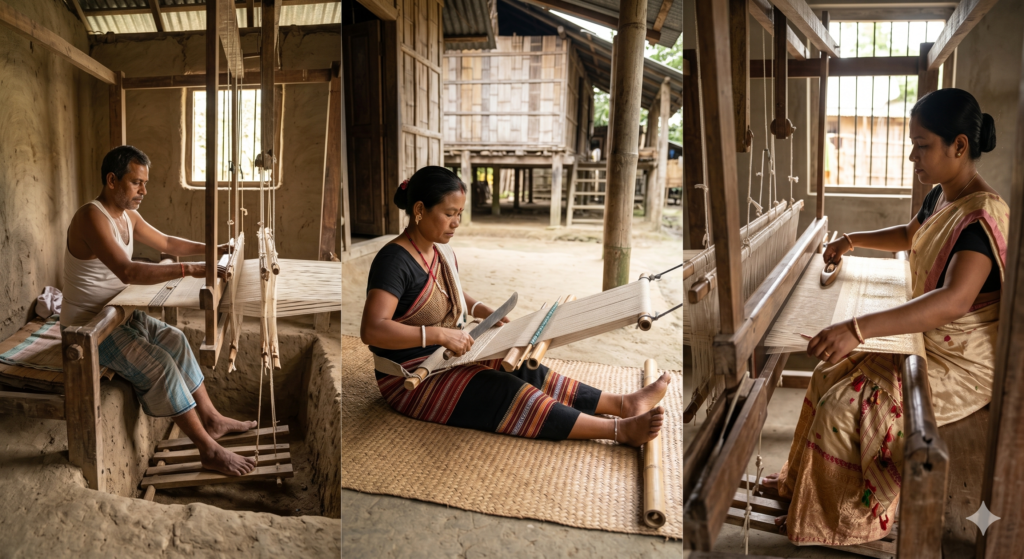
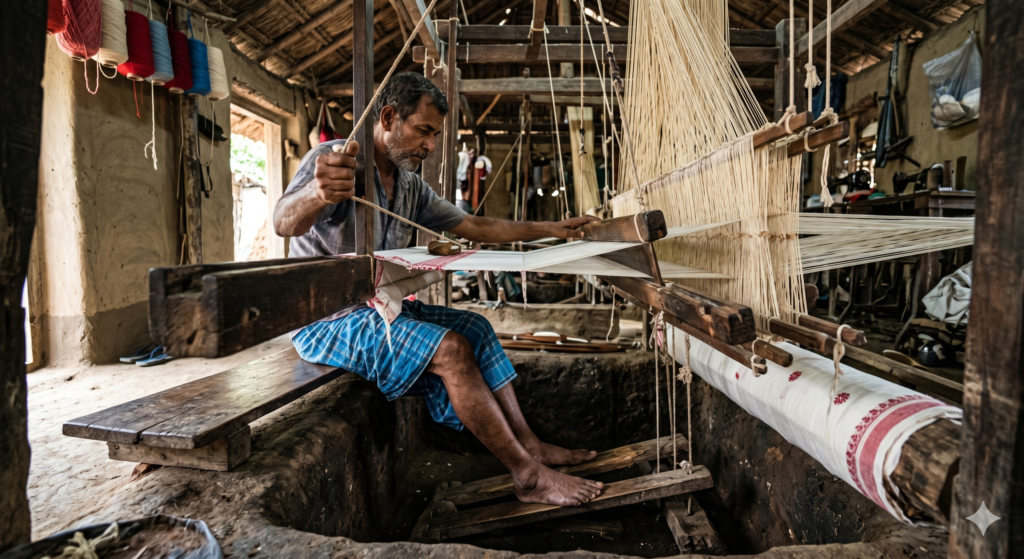
- Structure & Mechanics: In a Pit Loom, a pit is dug beneath the weaver’s feet where the pedals or treadles are installed. The weaver sits on the edge of the pit with legs lowered inside, using the pedals to separate the warp threads and create the ‘shed’.
- Shuttle Movement: These looms generally utilize Fly-shuttle technology. Pulling a central cord or handle propels the shuttle across the width of the fabric in the blink of an eye.
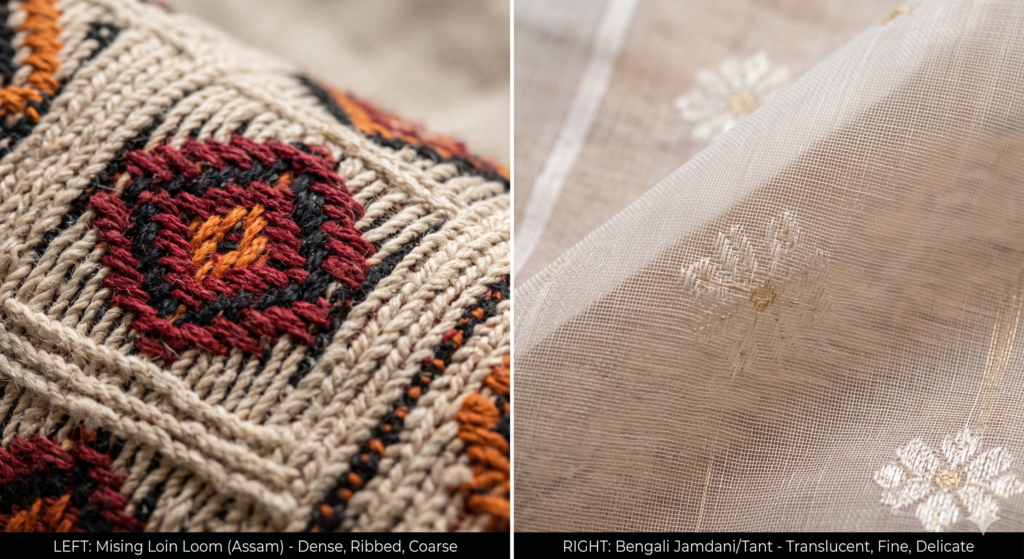
- Key Feature: Supported by a robust and permanent wooden frame, this setup allows for the rapid weaving of wide fabrics (usually 44 to 48 inches) like Tant or Jamdani sarees.
2. Assam’s Ancient ‘Loin Loom’ (Backstrap Loom)
A remarkable and prehistoric marvel of tribal weaving in hilly terrains is the Loin Loom, widely known as the Backstrap Loom. It is extensively used by the hill tribes of Assam and neighboring North-Eastern states.
- The Body-Machine Sync: This loom lacks a permanent wooden frame or pit; it is entirely portable. The far end of the warp threads is tied securely to a house wall, a wooden pillar, or bamboo poles, while the closer end is fastened around the weaver’s waist using a leather or fabric strap (the loin strap).
- Tension Control: The most fascinating aspect of this loom is how warp tension is managed. When the weaver sits on the ground with outstretched legs and leans back, the warp threads tighten. Shifting the body forward relaxes the threads. Thus, the weaver’s own body acts as the primary mechanical counterweight.
- Weaving & Constraints: There are no foot pedals; a flat wooden bar shaped like a sword (beater/sword) is used to manually beat and pack the weft. While it restricts the fabric width (usually 20 to 30 inches), the resulting weave is incredibly dense, sturdy, and heavy, making geometric motifs pop with a near three-dimensional texture. Mising and Karbi textiles are native to this loom.
3. The Throw-Shuttle Loom: The Soul of Assamese Silk
In the plains of Assam, especially in Sualkuchi, the traditional loom used for weaving premium Muga or Paat silk is the Throw-shuttle Loom.
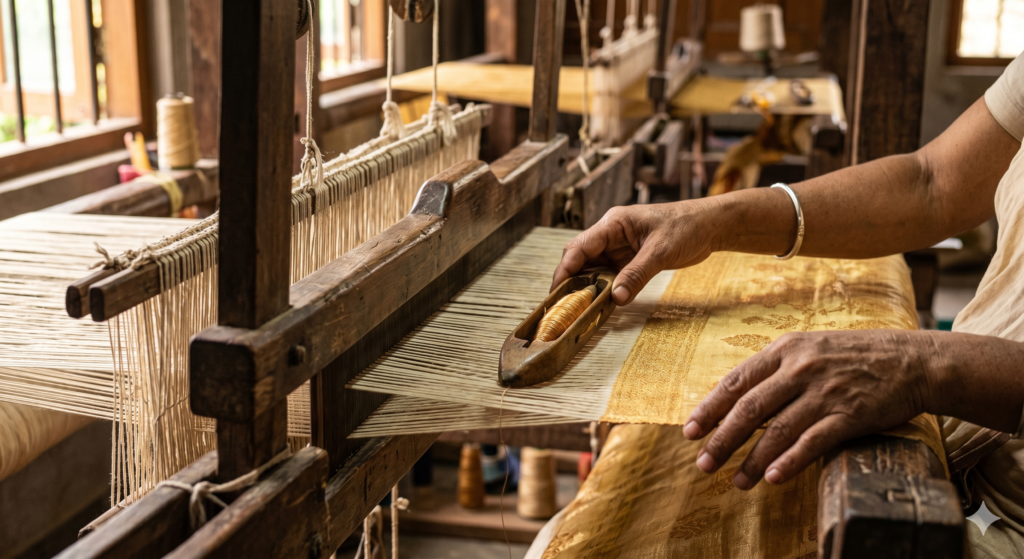
- Structural Difference: While its outer wooden structure resembles a Bengal frame loom, the shuttle mechanism is completely different. Unlike a fly-shuttle, there are no cords to pull.
- Weaving Technique: The weaver must manually hold and slide/throw the shuttle through the warp shed from one side, catching it with the other hand on the opposite side.
- Advantage & Time: While this manual throwing makes the weaving process significantly time-consuming, it grants absolute precision. It allows weavers to seamlessly integrate intricate and complex motifs or ‘butis’ directly into the core fabric. The pristine traditional patterns of the Mekhela Chador owe their flawless execution to this painstaking throw-shuttle mechanism.
Technical Comparison at a Glance:
| Feature | Bengal’s Loom (Pit/Frame) | Assam’s Loin Loom | Assam’s Throw-Shuttle Loom |
| Structure | Permanent wooden frame & pit | No permanent frame, portable | Permanent wooden frame |
| Tension Control | Mechanical rollers | Weaver’s body movement | Mechanical rollers |
| Shuttle Mechanism | Fly-shuttle (cord-pulled, high speed) | Manual wooden stick/shuttle insertion | Throw-shuttle (manually thrown & caught) |
| Fabric Type | Wide sarees, light texture (Tant/Jamdani) | Narrow width, heavy and dense weave | Medium width, premium silk (Muga/Paat) |
Conclusion
While Bengal’s looms are celebrated for speed, expansive widths, and fine textures, Assam’s loin loom is an ancient mechanical harmony between the human body and nature, and the throw-shuttle is a monument to infinite patience. Vunavya does not just trade in apparel; we are dedicated to honoring the technical labor and time-tested machinery of our native artisans.