
Discover the ancient art of making traditional Natural Dyes in Assam. Learn how tree barks, leaves, and fruits are turned into sustainable, eco-friendly colors.
Read this in – বাংলা/हिन्दी/असमिया
In today’s fashion world, where the toxic impact of chemical dyes is a major concern, the weavers in the remote villages of Assam are leading the way toward eco-friendly solutions. For generations, they have extracted vibrant colors directly from nature without using any synthetic chemicals. Today, in this special blog by Vunavya, we explore how the artisans of Assam use tree barks, leaves, and fruits to dye their exquisite fabrics.
1. The Magic of Blue: The ‘Rum’ Leaf
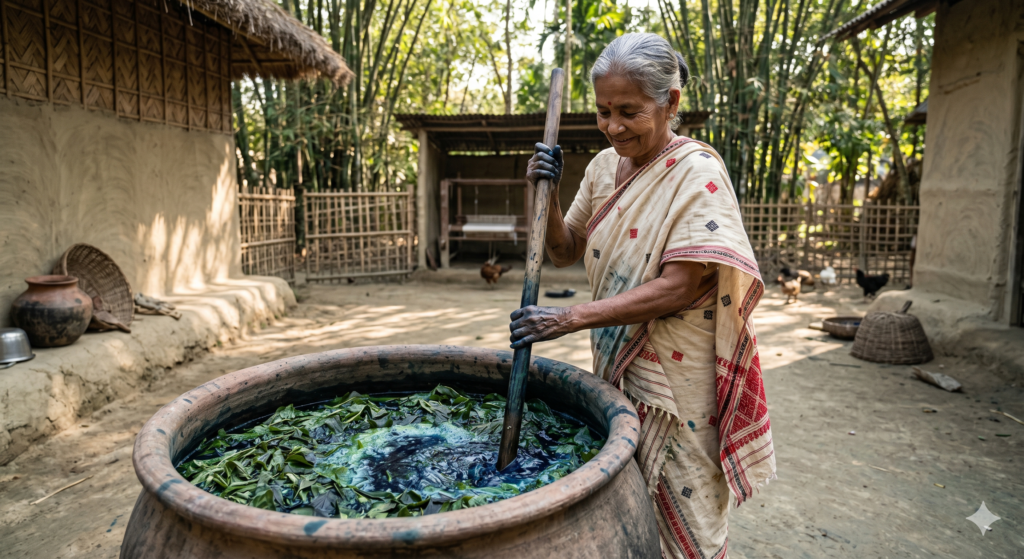
Tribal communities of Assam, particularly the Karbi and Tai Phake people, use the leaves of a unique plant to create a brilliant blue dye. This plant is locally known as ‘Rum’ (Strobilanthes cusia).
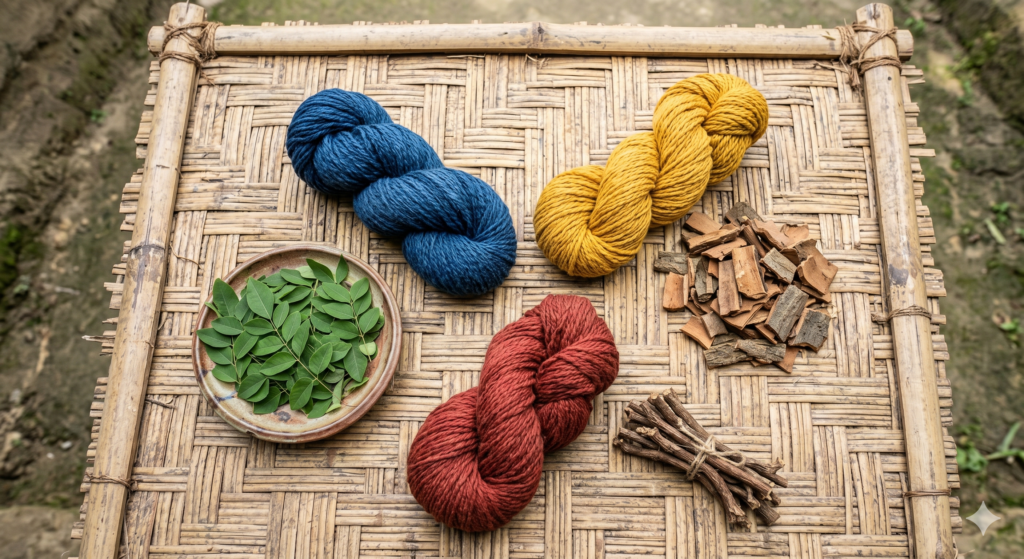
- The Process: The leaves of the Rum plant are harvested and left to ferment in large vats of water. After a meticulous process, a deep indigo-blue extract is obtained, creating a color that is remarkably colorfast and durable.
2. Royal Reds and Earthy Browns: Madder and Tree Barks
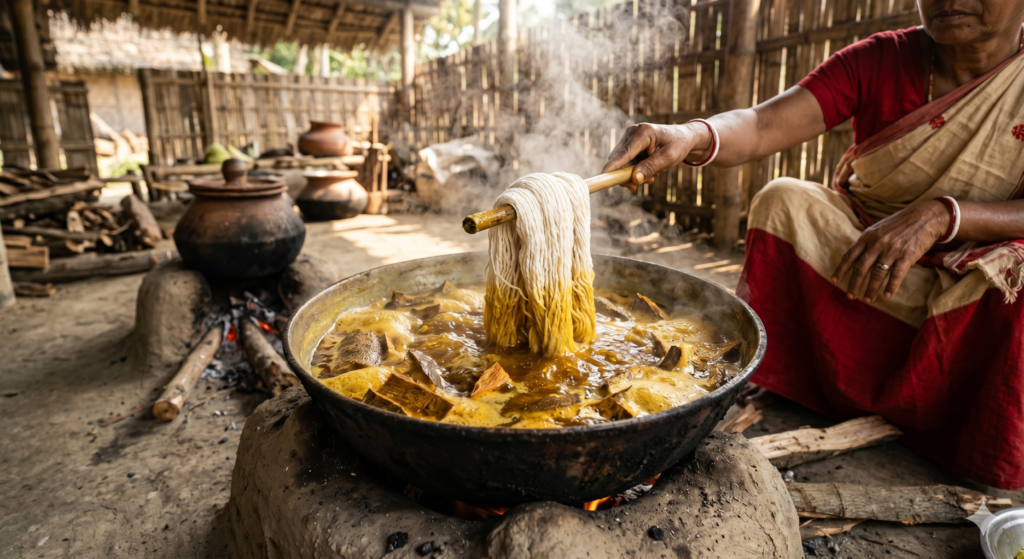
For traditional reds, maroons, and browns, Assamese weavers rely on Madder (Manjistha) roots or the bark of specific local trees.
- The Process: The barks or roots are sun-dried and ground into a fine powder. This powder is then boiled in water for hours to achieve deep red or chocolate-brown shades. Natural mordants like alum or iron-infused water are used to fix the dye permanently onto the yarn.
Why This Matters Today (Sustainability)
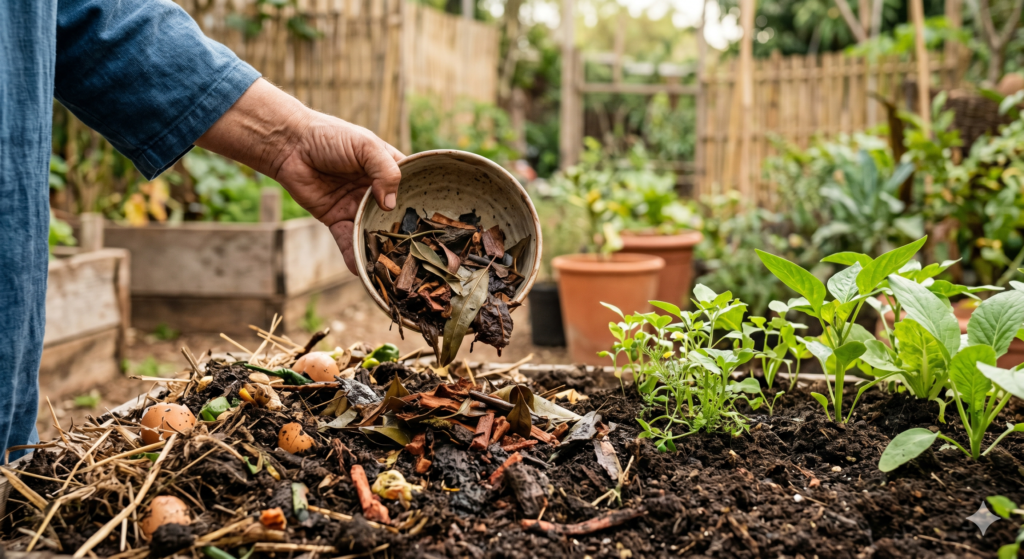
Unlike chemical dyeing, which pollutes water bodies with toxic effluents, Assam’s traditional method is 100% biodegradable. The bio-waste from this process easily decomposes into natural compost. It is a perfect example of how fashion can coexist beautifully with nature.
3. The Serenity of Yellow and Green
While raw turmeric is commonly used for the yellow color, a beautiful golden-yellow hue is also extracted by boiling jackfruit bark. Mixing this yellow with the blue extract of the Rum leaf creates a 100% natural green color.
Why is this method crucial today? (Sustainability)
The process of manufacturing chemical dyes releases tons of toxic wastewater that pollutes our rivers and water bodies. On the other hand, Assam’s traditional method is completely organic. The organic waste left over from making these dyes easily decomposes into the soil as natural compost. This ancient art of Assam is a prime example of how fashion can be made sustainable and beautiful without causing any harm to nature.