
By Dhananjoy Koley (Founder, Vunavya) | Last Updated: October 2026
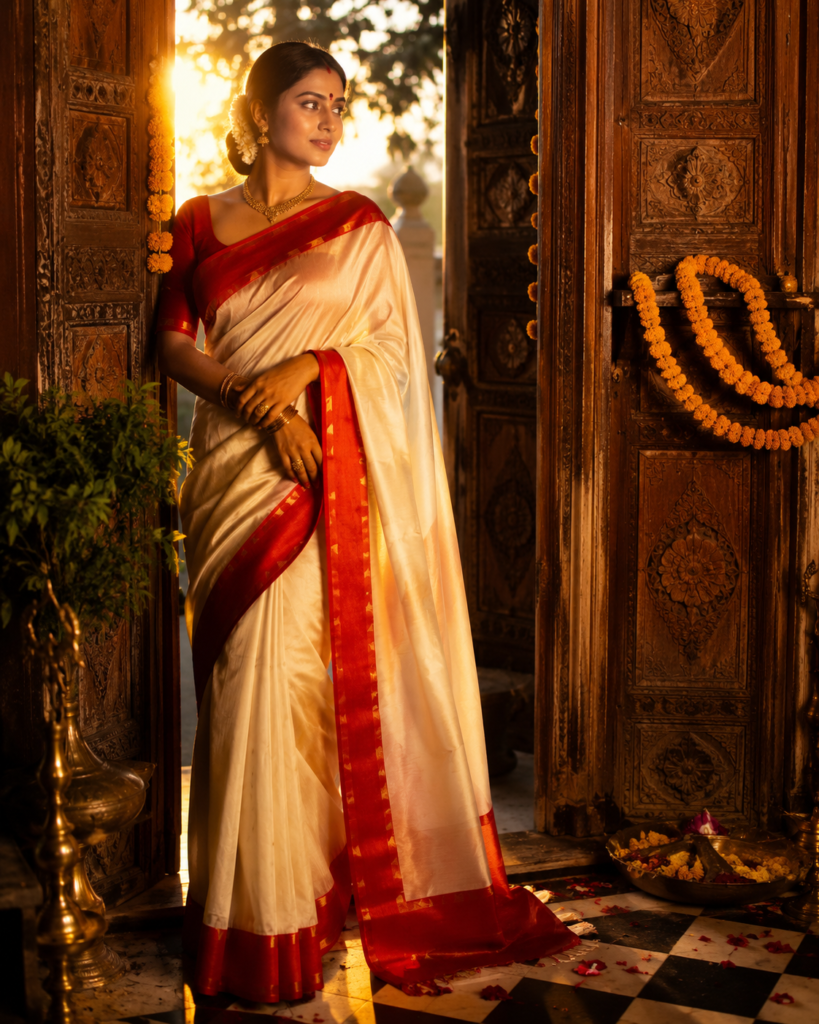
Among Bengal’s traditional silk textiles, the Garad saree holds a distinct place in religious rituals, weddings, and cultural festivals. Characterized by an unbleached, warm off-white silk body paired with a plain red or maroon border, the garment represents centuries of regional silk weaving. In this research-based guide from Vunavya’s ‘Textile Heritage’ series, we examine the origins of the Garad saree, the technical properties of raw Kora silk, how it differs from Korial weaves, retail price ranges, and practical ways to distinguish pure silk Garad from synthetic imitations.
Etymology and Weaving Centers in West Bengal
Textile historians generally trace the word ‘Garad’ to the Sanskrit and Old Bengali root ‘Gaur’, meaning white or unblemished. In traditional Hindu rituals across Bengal, garments woven from natural yarn without chemical bleaching or synthetic body dyes were considered ritually pure. Over time, this unbleached silk drape became essential attire for Durga Puja rituals and Bengali wedding ceremonies.
Historically and in present times, the primary weaving centers for Garad silk are located in the Murshidabad district (notably Mirzapur, Raghunathganj, and Jiaganj) and the Birbhum district (Tantipara and Baswa) of West Bengal. Weavers in these clusters continue to produce Garad sarees on traditional handlooms.

The Role of ‘Kora’ Silk and Sericin
What sets a traditional Garad saree apart from standard dyed silk sarees is how the silk yarn is prepared. In conventional silk processing, raw mulberry silk is boiled in alkaline water to remove sericin—the natural protein gum coating the silk filaments—before dyeing.
By contrast, the body of a classic Garad saree is woven using ‘Kora’ (undegummed and unbleached) Mulberry Silk. Because a portion of the natural sericin gum remains on the warp and weft threads, the base fabric retains its natural cream or off-white tone and feels noticeably crisp—almost like stiff paper—when new. Only the border and pallu yarns are degummed and dyed separately in shades of red, maroon, or green.
Types of Garad Sarees and General Retail Prices
Based on online handloom portals and state craft emporium listings that I checked in October 2026, Garad sarees are sold in four main varieties, with prices varying widely by seller, silk ply, and border work:
1. Classic Mulberry Silk Garad
Woven from 100% pure mulberry silk, this is the traditional form of Garad. It features an unornamented off-white body, a plain parallel red or maroon border, and simple stripes on the pallu.
General Price Range: Typically listed between ₹4,000 and ₹9,000 across online handloom stores.
2. Korial (or Banarasi-Style) Garad
When the red-and-white format is woven with denser, higher-ply silk using a three-shuttle interlocking technique (Korwai/Korial) and decorated with gold or silver zari motifs along the border and pallu, it is called a Korial saree.
General Price Range: Commonly ranges from ₹7,000 to ₹25,000+ depending on silk weight and zari density.
3. Tussar Silk Garad
Produced primarily in the Birbhum belt using Tussar silk, this version has a natural golden-beige base rather than cream white, paired with a red border and occasional small woven butis.
General Price Range: Usually priced between ₹3,500 and ₹7,500.
4. Cotton Tant Garad (Laal-Paar Saree)
For buyers seeking an affordable or summer-friendly alternative to silk, weavers produce the traditional red-bordered white saree in cotton yarn, similar to the Bengal handloom Tant sarees covered in our earlier guide.
General Price Range: Pure cotton versions generally retail between ₹600 and ₹1,500.
Practical Indicators to Identify Pure Silk Garad
Because many powerloom polyester and artificial silk (“art-silk”) sarees are marketed online as Garad, buyers can look for several physical and certification indicators:
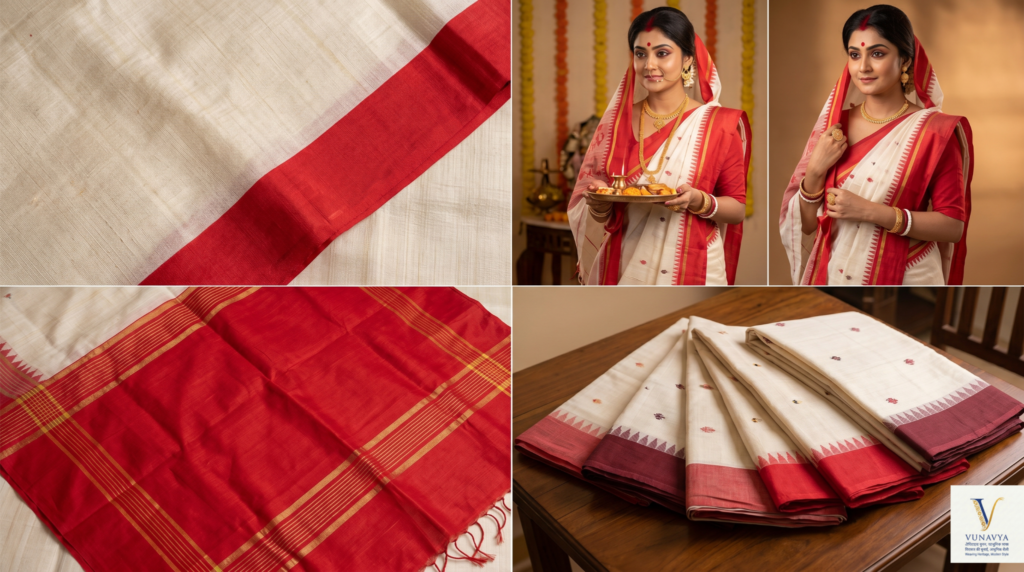
- Off-White Base Color: Because raw mulberry silk is unbleached, a genuine silk Garad has a warm cream or off-white tone with a soft sheen. Sarees that appear optically bright white with a harsh metallic glare are often bleached synthetic blends.
- Crisp Initial Texture and Light Weight: Due to the natural sericin gum in Kora silk, a new Garad feels crisp and slightly papery to the touch while remaining very lightweight. Over several dry-cleaning cycles, the fabric gradually softens.
- Reverse Border Weave: On a handloom Garad, turning the border over reveals subtle variations in thread tension characteristic of hand-thrown shuttles, unlike the uniform finish of factory powerlooms.
- Official Silk Mark and Handloom Mark: The most reliable way to confirm fiber purity is to check for the Silk Mark hologram issued by the Central Silk Board, Government of India, alongside the official Handloom Mark tag.
Author’s Note: While reviewing online retail listings for this guide, I noticed that many e-commerce sellers use “Garad Saree” in the product title for sarees priced under ₹1,000, while listing the fabric material in the fine print as “Art Silk,” “Poly-Silk,” or “Synthetic.” Always check the material specification tab and look for Silk Mark certification if you are looking for real mulberry silk.
Care and Storage Tips
Because a Garad saree combines a light unbleached body with a dark red border, washing it in water at home carries a high risk of dye bleeding from the border onto the cream silk. Pure silk Garad sarees should always be dry-cleaned. For storage, wrap the saree in a clean, breathable cotton or muslin cloth rather than plastic bags, and refold it periodically to prevent permanent crease stress on the silk fibers.
Frequently Asked Questions (FAQ)
Q: What is the difference between a Garad saree and a Korial saree?
Answer: A traditional Garad saree is lightweight, woven from undegummed (Kora) mulberry silk with a plain off-white body and a simple red border without heavy zari work. A Korial saree uses denser silk with a three-shuttle interlocked border and features elaborate gold or silver zari motifs.
Q: Why does a new Garad silk saree feel stiff like paper?
Answer: Garad is woven using raw, unbleached mulberry silk that retains its natural protein coating called sericin. This natural gum gives the new saree a crisp, papery feel that softens over time after dry cleaning.
References & Further Reading:
- Silk Mark Organization of India (Central Silk Board, Ministry of Textiles): silkmarkindia.com
- Office of the Development Commissioner (Handlooms), Ministry of Textiles: handlooms.nic.in