
By Dhananjoy Koley, Founder, Vunavya | Last updated: November 2026
Jamdani is one of the finest hand-woven textiles of Bengal, and also one of the most imitated. If you have ever wondered how a real handloom Jamdani differs from a machine-made look-alike, this guide is for you.
A quick word about me. I am Dhananjoy, and I am preparing to start Vunavya, an online handloom saree business. I have visited two handloom saree weaving units near my home, but I have not yet visited a Jamdani weaving cluster. So this guide is built from books, official and international sources and careful reading, not from first-hand time with Jamdani weavers. Once I visit Jamdani weavers, I will update it with my own photos and notes. I would rather tell you this clearly at the start.
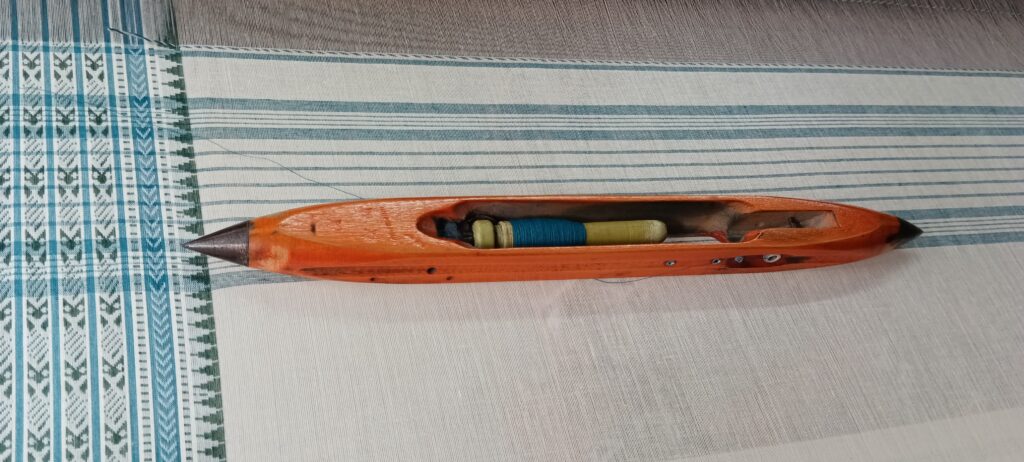
What is Jamdani?
Jamdani is a figured textile in which the motifs are woven into the cloth while it is being woven. They are not printed or embroidered afterwards. Traditionally it is made with fine cotton yarn, and sometimes with silk or metallic zari. The technique uses an extra (supplementary) weft thread that the weaver places by hand to build each motif on the base fabric.
Name and history
The origin of the word is explained in more than one way. A commonly repeated explanation links it to Persian words meaning “flower” and “vase”. Other writers connect it to Persian words for “cloth” and “dot”. I am not claiming that any one explanation is final.
The craft is historically associated with the Dhaka region of undivided Bengal, now in Bangladesh, and is often described as a successor to the fine muslin tradition. In 2013, UNESCO inscribed “Traditional art of Jamdani weaving” on its Intangible Cultural Heritage list. That inscription is in the name of Bangladesh.
In West Bengal, places such as Phulia and Shantipur in Nadia and parts of Purba Bardhaman are commonly mentioned in connection with Jamdani weaving. Many weaving families are said to have moved to West Bengal after the Partition of 1947.
How is it woven?
On the loom, the base cloth is made with warp and weft threads. For each motif, extra threads are then placed by hand, and often two people work side by side. Because every motif is placed individually, a densely patterned saree takes longer. Depending on design density, yarn fineness and the number of weavers, a single saree can take anywhere from several days to a few months.
The finer details of the weavers’ methods, and the local names of their tools, differ from place to place. I will add them once I have learned them first-hand.
Yarn and materials
Fine cotton is the traditional base, and the finer the yarn, the lighter and more breathable the cloth. Some sarees use silk or cotton-silk blends, and some use metallic zari in the motifs. When buying, ask the seller exactly what the yarn and the zari are. Claims such as “real gold zari” are hard to check by eye.
A few motif names
Motif styles commonly mentioned in books and by sellers include butidar (small flowers scattered across the body), tercha (motifs arranged diagonally) and panna hazar. Spellings and usage vary from place to place.
How to tell handloom Jamdani from a machine-made look-alike
No single test is enough on its own. Use several signs together, and ask the seller questions.
- Look at the back of the saree: In hand-woven work the extra threads are woven into the cloth, so the back usually looks fairly tidy, with small trimmed ends. Many machine-made imitations show longer floating threads between motifs, which are cut afterwards. Ask the seller to show you the back, and if you are unsure, compare it with a saree you know is handloom.
- Look closely at the motifs: Hand-placed motifs can show small natural differences. But skilled weavers can also be very consistent, and some machines do good work, so treat this only as a hint.
- Weight and feel: Fine cotton Jamdani is usually light and soft. A very stiff, heavy or artificially shiny feel can suggest blended or synthetic yarn. A new saree may feel stiff at first because of starch, so ask the seller.
- Hold it up to the light: Fine cotton Jamdani is often semi-transparent. If the cloth is thick and stuffy, ask more questions.
- Pallu and edges: Hand-twisted fringes or knots can point to hand finishing, and machine-hemmed edges can point to factory work. This is not proof either.
- Ask for proof: Ask for the weaver’s or society’s name and a proper bill, and ask whether there is a Handloom Mark (Ministry of Textiles, Government of India). For silk, look for the Silk Mark (Central Silk Board). Verify any tag or label on the issuing body’s official website before you trust it. A tag alone is not a guarantee, and not every genuine handloom saree carries one.
- Pinholes at the edge: You may read that pinholes at the border prove a saree is handloom. I do not rely on this, because looms of other kinds also use similar devices to hold the cloth taut.
| Feature | Hand-woven Jamdani | Machine-made imitation (typically) |
|---|---|---|
| How motifs are made | Extra threads placed by hand | Machine produces the motifs |
| Back of the cloth | Fairly tidy, trimmed ends | Often long floating threads |
| Variation in motifs | Small natural differences possible | Often identical |
| Time to make | Several days to months | Much less |
| Seller can name | Weaver, society or village | Often a vague answer |
This table gives general hints, not fixed rules.
A note on price
I am not listing a price range here, because I have not yet collected and checked prices myself. Jamdani prices vary a great deal with yarn fineness, design density, size and seller. What I can say is that a hand-woven saree takes a skilled weaver many days, so a price that looks far too low for the work claimed is a reason to ask questions. Compare sarees with similar yarn and design from several sellers, and ask how many days the saree took to weave.
Questions to ask the seller before you buy
- Which weaver, society or village made this saree?
- Is it handloom or power loom? Can you show me the back?
- What is the yarn (cotton, silk, blend)? What kind of zari is used?
- Is there a Handloom Mark or any other proof that I can verify?
- How long did it take to weave?
- What is the return or exchange policy?
Caring for your saree
Follow the care instructions given by the seller or weaver first. In general, these habits help:
- Washing: Dry cleaning is the safest option, especially for silk, zari or heavily patterned sarees. If you wash at home, use cold water and a mild detergent, handle gently and do not wring.
- Ironing: On the reverse side, with a thin cotton cloth in between, on low to medium heat.
- Drying: In the shade, not in strong sunlight.
- Storage: Wrap in soft cotton or muslin, not plastic. Refold along different lines every few months so the threads do not weaken at the same creases.
- Against insects: Avoid putting mothballs in direct contact with the saree, especially near zari. Dried neem leaves in a small cotton pouch are a gentler option.
A note from the author
I am new to this field. Vunavya is still being set up. Before I begin selling, I am using this time to study, learn about handloom weaving and write guides based on checked information. After I visit Jamdani weaving clusters, I will add my own photos, videos and what the weavers teach me to this post. If you notice a mistake, I would be grateful if you could let me know through the contact option on the Vunavya website.
Frequently asked questions
Is every Jamdani hand-woven?
Traditional Jamdani is hand-woven. But in the market the name “Jamdani” is often used loosely for machine-made, Jamdani-style sarees too. So before buying, ask whether the saree is handloom.
Which Jamdani is comfortable in hot weather?
Fine cotton Jamdani is usually lighter and more comfortable than silk or blended ones.
Can I tell real from fake from online photos?
It is difficult. Ask for close-up photos of the front and the back, and a short video if possible, and verify the weaver or society details.
References
- UNESCO, Traditional art of Jamdani weaving (2013): ich.unesco.org
- Ministry of Textiles, Government of India, Handlooms and Handloom Mark: handlooms.nic.in
- Silk Mark Organisation of India (Central Silk Board): silkmarkindia.com