
The Tapestry of Bengal’s Woven Motifs, Folklore, and Heritage of Nakshi Kantha
If we delve into the history of Bengal’s textile industry, we find many gems that are celebrated not just in India, but across the globe. Today, on Vunavya‘s Textile Heritage page, we will tell the story of a craft that is not just a stitch, but a canvas of hundreds of years of emotions, folklore, and the lives of Bengali women. The name of this unparalleled art form is— Nakshi Kantha.
The Birth of Nakshi Kantha: Breathing New Life into Old Fabrics
The word ‘Nakshi’ means pattern or design. In the olden days, to protect themselves from the winter, women in rural Bengal would layer old cotton sarees or dhotis and stitch them together using colored threads pulled from the saree borders. This practice is still alive in the heart of rural Bengal. It was an extraordinary indigenous way of recycling discarded or old clothes. Indians have always possessed a ‘Jugaadu’ (resourceful and innovative) mindset since ancient times. Whether it was the onset of winter or the birth of a new child in the family, the work of weaving a Kantha would begin in every household. Grandmothers, aunts, and elderly women would come together to craft large quilts for the winter and tiny, soft Kanthas as gifts for newborns. When these ordinary stitches blossomed into various patterns and stories, it became known as ‘Nakshi Kantha’.
The Canvas of Storytelling
Nakshi Kantha is often called the ‘diary’ of Bengali women. Hundreds of years ago, when women did not have many mediums to speak their minds or practice art, they used needles and threads to depict their joys, sorrows, fairytales, and daily lives on fabric. Sitting on their porches during lazy afternoons, the dreams and love of these women became intertwined with the weaving of the cloth.
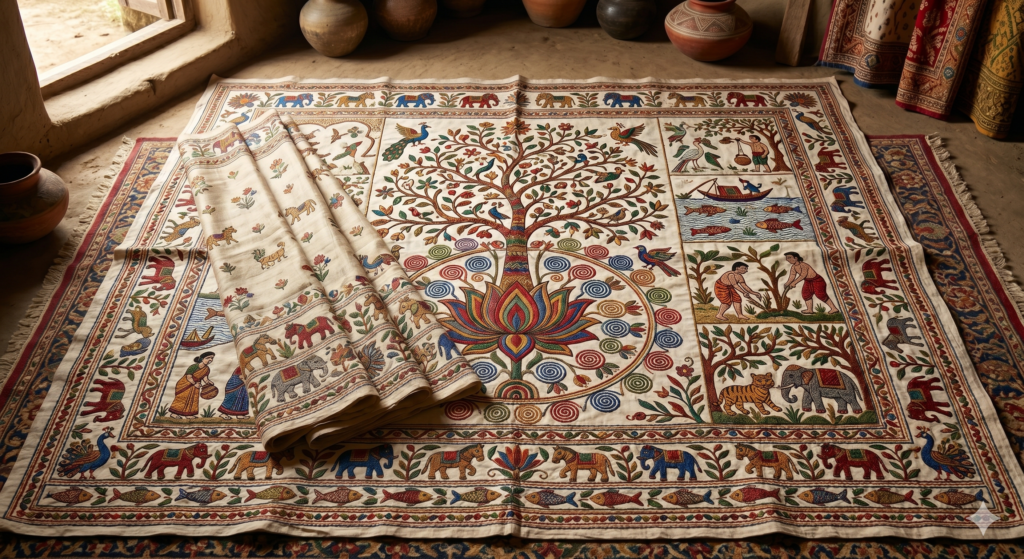
Popular Motifs: Reflections of Rural Bengal Nakshi Kantha typically carries the essence of rural Bengal’s nature and everyday life. Some of the most prominent motifs include:
- The Centerpiece: Usually, a fully bloomed lotus sits right in the middle.
- Nature: The Tree of Life, leaves, and various kinds of flowers.
- Animal Kingdom: Birds, fishes, elephants, horses, and peacocks.
- Daily Life: Ordinary village scenes, palanquins, and various mythological tales.
Geographical Indication and Major Hubs (The GI Tag)
This unique art of Bengal received the Geographical Indication (GI) tag at the international level in 2008. Although the entire state of West Bengal holds this tag, the most flawless and authentic Nakshi Kantha work is done in a few specific districts:
- Birbhum: Areas like Bolpur, Shantiniketan, and Nanoor can be called the capital of Nakshi Kantha. Thousands of women artisans here have been carrying on this legacy for generations. The modern transformation this art saw in Shantiniketan, guided by Rabindranath Tagore, is now globally acclaimed.
- Murshidabad & Bardhaman: Alongside Birbhum, areas like Kandi in Murshidabad and Ketugram and Mangalkot in Purba Bardhaman also produce incredibly fine and traditional Kantha work.
Evolution in Modern Fashion Over time, Nakshi Kantha has crossed the boundaries of old clothes and quilts to enter the realm of modern luxury fashion. Today, Kantha stitch work is done on Bengal’s premium handloom sarees, such as Pure Tussar, Bishnupuri Silk, Murshidabad Silk, Garad, and Khadi Cotton. It can take an artisan anywhere from 3 to 6 months to complete a heavily worked Nakshi Kantha saree! Imagine a craft that originated merely to fulfill a basic need is now being used to create luxury brands and is receiving global respect.
Vunavya believes that true fashion is not just about outward beauty, but about staying connected to your roots. We are committed to honoring these ancient artisans of Bengal and bringing the magic of their hands right to your doorstep.
Share this article to help spread the word about this incredible art form of Bengal!