
Shantiniketan Batik: Bengal’s Exquisite Heritage Born of Wax and Colors
The history of Bengal’s textiles is not limited to just the weaving of threads; it has taken on a unique form through the magical touch of colors, brushes, and wax. Today, on Vunavya’s ‘Textile Heritage’ page, we will discuss an art form that carries the scent of Shantiniketan’s red soil and is celebrated worldwide. The name of this vibrant and colorful art is— Batik.
The History of Batik:
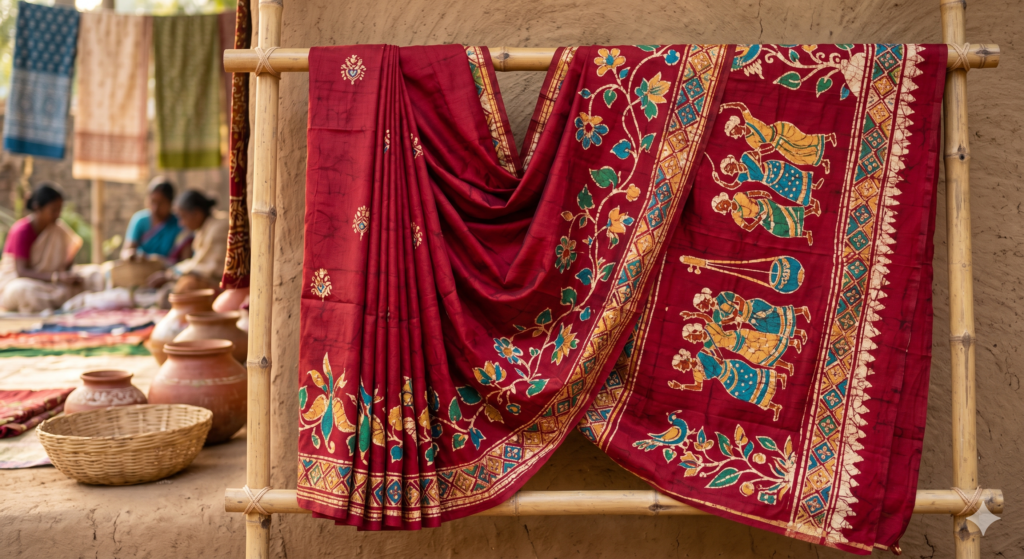
From Java to Shantiniketan The word ‘Batik’ originally comes from the Indonesian word ‘Ambatik’, which means ‘to draw with dots’. Although the origin of this art lies in the island of Java, Indonesia, the greatest contribution to popularizing this art in Bengal belongs to the global poet, Rabindranath Tagore. When he visited Indonesia in the 1920s, he was mesmerized by this unparalleled art form. Later, he and his son Rathindranath Tagore introduced this craft at Kala Bhavana in Shantiniketan. Since then, Batik has become an intrinsic and signature art form of Shantiniketan.
The Magical Technique of Wax and Colors (Wax-Resist Dyeing)
The process of creating Batik is highly scientific and fascinating. It is not just ordinary block printing. Batik is a ‘wax-resist dyeing’ technique.
- First, a design is drawn with a pencil on pure white silk or cotton fabric.
- Then, a mixture of melted wax and resin is carefully applied to specific parts of the design using a brush or a special tool (tjanting). The waxed area hardens.
- The entire fabric is then dipped into a vat of cold dye. The areas covered with wax resist the dye and remain uncolored.
- After dyeing, the fabric is boiled in hot water, causing the wax to melt away and revealing the magical design on the fabric! If multiple colors are desired, this process is repeated several times.
The Crackle Effect:
The Signature of Authentic Batik The most attractive and authentic feature of Batik art is its ‘Crackle Effect’. As the fabric is dyed, the dried wax layer develops tiny cracks, allowing fine veins of dye to seep through. This creates a beautiful web of intricate, hairline patterns on the fabric. This crackle design cannot be perfectly replicated by any machine. This is the ultimate proof that the Batik is entirely handmade.
Popular Motifs:
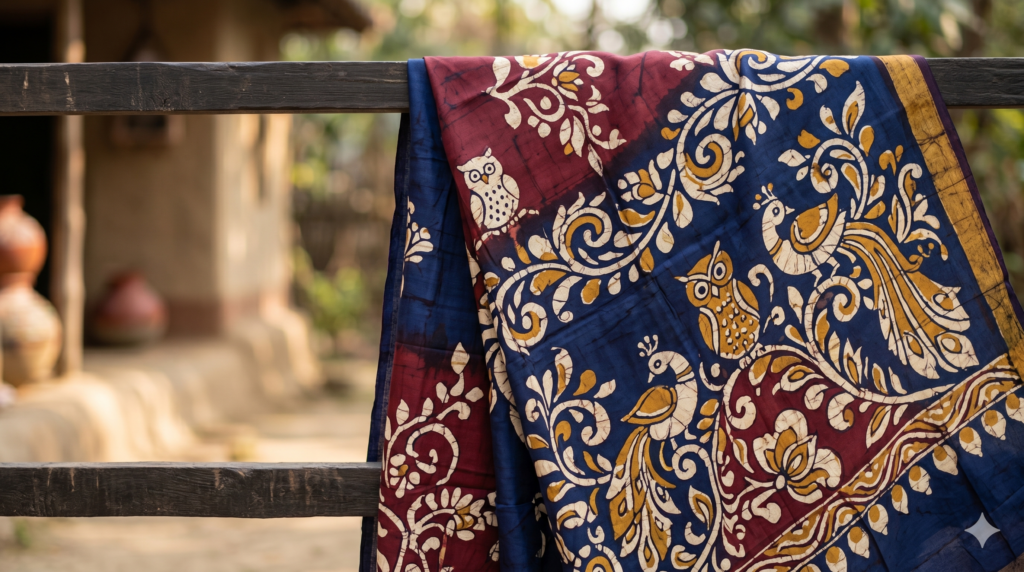
A Blend of Nature and Culture Shantiniketan’s Batik is heavily influenced by Bengal’s nature and folk culture. The most common motifs found in this style include:
- Nature: Flowers, leaves, vines, and trees.
- Animal Kingdom: Fishes, birds, and peacocks.
- Folk Culture: Baul singers, Santhal tribal dances, the Ektara (a musical instrument), and scenes of rural life.
- Geometric Shapes: Various abstract and geometric patterns are also very popular in modern Batik.
Batik in Modern Fashion Today, Shantiniketan’s Batik is no longer limited to just bedsheets or dupattas. Batik work on Pure Silk, Tussar, Murshidabad Silk, and premium cotton sarees is now a ‘statement piece’ in the fashion world. A beautiful Batik saree is not only a symbol of elegance but also extremely comfortable to wear.
Vunavya honors this traditional art of Bengal and the tireless efforts of its artisans. Behind every handmade Batik saree lies the story of an artisan’s days of struggle with wax and colors. Even in this age of machines, our goal is to bring the masterpieces of those who have kept this ancient art alive directly to you.
Do you have a favorite Batik saree or kurti in your wardrobe? Which Batik motif do you love the most? Let us know in the comments!