
By Dhananjoy Koley (Founder, Vunavya) | Last Updated: October 2026
Read this in :- বাংলা / हिन्दी
Among the traditional needlework crafts of the Indian subcontinent, Nakshi Kantha stands out as an enduring folk embroidery tradition from Bengal. Built around the simple running stitch (Kantha Phoor), the craft originated as a household practice of repurposing worn-out cotton fabrics into quilted wraps filled with folk motifs. In this research-based guide from Vunavya’s ‘Textile Heritage’ series, we examine the historical origins of Nakshi Kantha, its traditional motifs, key embroidery centers in West Bengal, retail price ranges for modern Kantha stitch sarees, and practical ways to tell hand-stitched Kantha apart from machine embroidery.
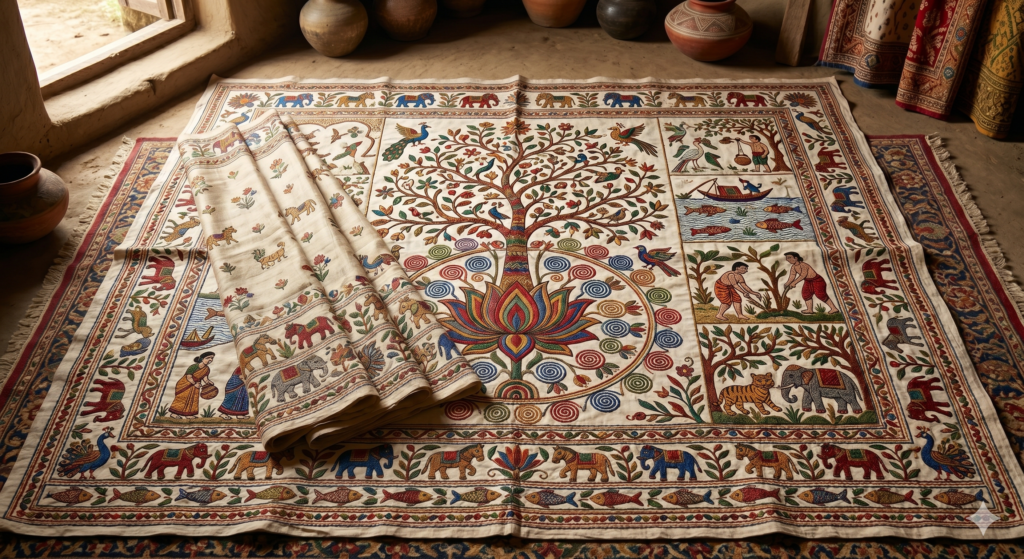
Origins of Nakshi Kantha: Upcycling Household Cotton
Linguistically, the word ‘Kantha’ is linked to the Sanskrit term ‘Kontha’, meaning rags or patched cloth, while ‘Nakshi’ derives from ‘Naksha’, referring to artistic patterns. Long before modern terms like “upcycling” became popular, rural women in Bengal practiced a resourceful method of extending the life of household textiles.
When old Bengal cotton Tant sarees or dhotis grew too thin to wear, women washed and layered four to seven sheets of the softened white cloth together. Colored threads were drawn out from the borders of discarded sarees and used to quilt the layers together with fine running stitches. Used as light winter wraps or soft mats for newborns, these quilts became known as Nakshi Kantha when artisans began stitching intricate floral, geometric, and narrative scenes across the cloth. Literary references to Kantha appear as early as Krishnadasa Kaviraja’s 16th-century text Chaitanya Charitamrita and later in poet Jasimuddin’s well-known 1929 ballad ‘Nakshi Kanthar Math’.
Traditional Motifs and Stitch Variations
Traditional Nakshi Kantha designs reflect the natural environment, rituals, and daily life of rural Bengal. Common visual elements include:
- The Central Lotus (Shatadal Padma): Many classical Kanthas feature a blooming hundred-petaled lotus or concentric mandala at the center.
- Tree of Life and Kalka Corners: The four corners often hold stylized Trees of Life (Kalpavriksha) or mango paisley (Kalka) motifs extending inward.
- Fauna and Everyday Scenes: Fish, peacocks, owls, elephants, horses, wedding palanquins (Palki), river boats, and folk dancers.
- Stitch Variations: Alongside the standard running stitch, artisans adjust thread alignment to create patterns such as Dhaner Sheesh (paddy-stalk stitch), Lik Phoor, and Paati Phoor, which give the fabric a subtle rippled texture.
Geographical Indication (GI) Registration and Major Hubs
Nakshi Kantha is registered under the Geographical Indications (GI) Registry of India for West Bengal. Today, the craft is practiced prominently across several districts:
- Birbhum District (Santiniketan, Bolpur, and Nanoor): In the early 20th century, craft revival efforts at Kala Bhavana and Shilpa Sadana (Sriniketan)—supported by Pratima Devi—helped adapt rural Kantha embroidery onto wearable garments. Over the decades, women artisans in villages such as Nanoor and around Bolpur have made Birbhum the primary center for commercial Kantha stitch sarees.
- Murshidabad and Purba Bardhaman: Artisan clusters in parts of Murshidabad and Purba Bardhaman districts are also recognized for traditional quilted spreads and fine Kantha needlework.
Modern Kantha Stitch Sarees and General Retail Prices
In contemporary handloom fashion, the running stitch of Nakshi Kantha is widely worked onto single-layer sarees made of Pure Tussar Silk, Murshidabad and Bishnupuri Mulberry Silk, and Cotton or Khadi. Depending on how densely the motifs cover the fabric, a single hand-embroidered Kantha saree can take an artisan anywhere from one month to over six months to complete.
Prices listed by online craft portals and handloom retailers that I checked in October 2026 ranged as follows (prices vary widely by seller, base fabric, and stitch density):
- Cotton and Khadi Kantha Stitch Sarees: Hand-embroidered cotton Kantha sarees are typically listed between ₹1,800 and ₹4,500.
- Tussar and Mulberry Silk Kantha Sarees: Hand-stitched Kantha on pure Tussar or Mulberry silk generally ranges from ₹6,000 to ₹18,000 for standard border, pallu, and body work.
- Heavily Embroidered or ‘Reverse Kantha’ Silk Sarees: Full-coverage sarees where the background is densely filled with running stitches commonly retail from ₹15,000 to ₹25,000+.
How to Tell Hand-Stitched Kantha Apart from Machine Embroidery
Because machine-embroidered sarees are frequently sold online under the label “Kantha Work,” buyers can look for a few practical indicators:
- Slight Organic Variation in Stitches: Because a human hand guides the needle, genuine hand-stitched Kantha shows tiny, natural variations in stitch length and spacing when viewed up close. Computerized machine embroidery produces rigid, identical lock-stitches.
- Subtle Surface Gathering: Hand-pulled running stitches create a soft, slight puckering or wave-like texture across the silk or cotton fabric, whereas machine work often feels flat and stiff.
- Silk Mark Verification: When buying Tussar or Mulberry silk Kantha sarees, check for the official Silk Mark tag from the Central Silk Board, Government of India to confirm the purity of the base silk.
Author’s Note: While checking online retail listings for this guide, I noticed many sarees titled “Santiniketan Kantha Stitch Saree” priced between ₹800 and ₹1,200. Since hand-embroidering a full saree takes an artisan several weeks to several months of manual labor, listings in that low price bracket are almost always machine-embroidered or screen-printed imitations. Always check the product description for “Hand-embroidered” and verify the base fabric before purchasing.
Care and Maintenance
Just like the Santiniketan Batik silk sarees discussed in our related guide, pure Tussar and Mulberry silk Kantha sarees should be dry-cleaned. Cotton Kantha sarees can be gently hand-washed in cold water using a mild liquid detergent—never scrub the embroidered threads with a brush. Always dry in the shade and iron on the reverse side over a thin pressing cloth.
Frequently Asked Questions (FAQ)
Q: What is the difference between traditional Nakshi Kantha and a Kantha Stitch Saree?
Answer: Traditional Nakshi Kantha is a multi-layered quilted wrap or coverlet made by stitching several layers of old cotton cloth together. A Kantha Stitch Saree applies that same running-stitch embroidery technique and motif style onto a single-layer silk, Tussar, or cotton saree.
Q: What is ‘Reverse Kantha’ embroidery?
Answer: In standard Kantha work, colored threads fill in the motifs against a plain background. In ‘Reverse Kantha,’ the artisan fills the entire background of the saree with closely packed running stitches while leaving the motifs un-stitched, requiring several months of intensive handwork.
References & Further Reading:
- Geographical Indications Registry (Government of India) — GI Registered Crafts of West Bengal (Nakshi Kantha): ipindia.gov.in
- Visva-Bharati University — History of Sriniketan & Shilpa Sadana Rural Craft Initiatives: visvabharati.ac.in/Sriniketan.html
- Silk Mark Organization of India (Central Silk Board, Ministry of Textiles): silkmarkindia.com