
By Dhananjoy Koley | Last Updated: October 2026
Bengal’s textile traditions extend beyond loom-woven sarees to include distinct surface-dyeing crafts developed over the last century. In this research guide from Vunavya’s ‘Textile Heritage’ series, we examine Santiniketan Batik Art—tracing how wax-resist dyeing took root at Visva-Bharati in the 1920s, the technical process of using beeswax and paraffin with cold-water dyes, and practical ways to tell hand-waxed Batik apart from factory screen prints.
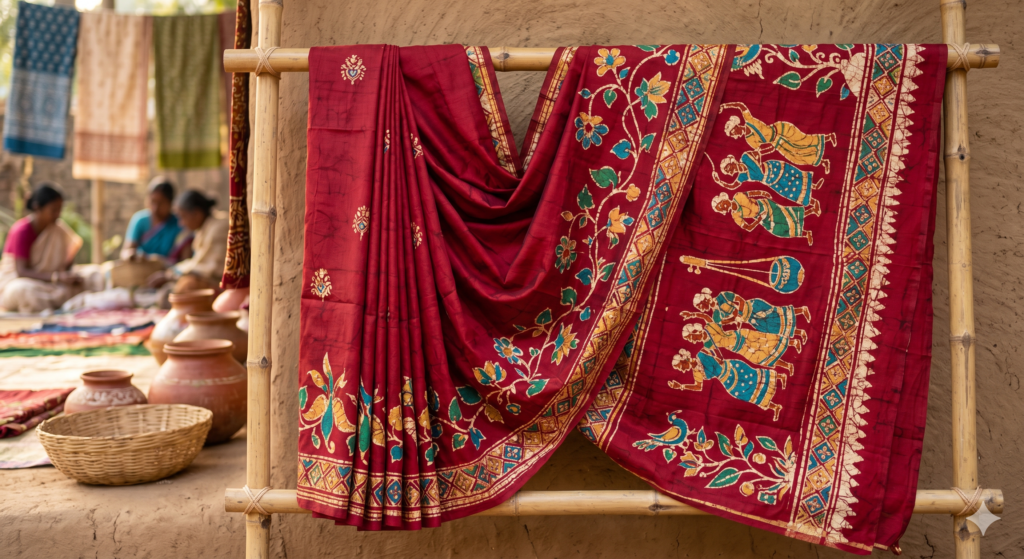
Historical Background: From Java to Santiniketan
The word ‘Batik’ comes from the Javanese term ‘Ambatik’, referring to drawing with dots or wax drops. While the craft has ancient roots in Indonesia—where it is inscribed on the UNESCO Intangible Cultural Heritage List—its systematic practice in Bengal began in the 1920s at Santiniketan in Birbhum district.
According to the institutional history of Visva-Bharati’s rural craft wing, Batik gained prominence following Rabindranath Tagore’s 1927 visit to Java and Bali, from where he brought back original Javanese Batik samples. Under the initiative of Rathindranath Tagore and Pratima Devi, wax-resist dyeing was introduced at Kala Bhavana and the craft training workshops of Shilpa Sadana (Sriniketan). Rather than replicating Indonesian patterns, Santiniketan artists merged the wax-resist technique with traditional Bengali Alpona motifs and local folk themes.
How the Wax-Resist Dyeing Process Works
Unlike direct block or screen printing, where dye paste is pressed onto the surface of a cloth, Batik is a wax-resist dyeing method. Molten wax is applied to selected parts of the fabric to block dye from penetrating those fibers. The traditional process follows several stages:
- Desizing the Fabric: Unbleached or white pure cotton, Tussar, or Mulberry silk is washed thoroughly to remove any loom starch or gum so that wax and dye can penetrate the yarn evenly.
- Preparing the Wax Mixture: Artisans typically blend beeswax and paraffin wax (sometimes adding a small amount of pine rosin). Beeswax is pliable and adheres closely to the cloth to block dye completely, while paraffin wax is more brittle when cooled, allowing tiny cracks to form. The exact ratio of beeswax to paraffin varies depending on the artisan, the fabric weight, and how much crackle effect is desired.
- Waxing the Design: The fabric is stretched flat over a wooden frame. Following a light pencil outline, the artisan applies hot molten wax using paintbrushes or a spouted tool over all areas meant to retain the base color.
- Cold-Water Dyeing (Light to Dark): Because hot water would melt the wax barrier, Batik fabrics are dyed in cold-water dye baths using Naphthol, Vat, or cold-reactive dyes. For multi-colored sarees, dyeing progresses from the lightest shade (such as yellow) to darker shades (red, brown, or black), with additional wax applied after each drying stage.
- De-waxing: Once all dyeing stages are complete, cotton fabrics are traditionally washed in boiling soapy water to melt away the wax. For delicate protein fibers like pure silk and Tussar, artisans use carefully temperature-controlled hot water or specialized de-waxing methods to remove the wax without damaging the silk sheen.

The Crackle Effect and Common Motifs
A recognizable feature of wax-resist Batik is the crackle effect. When hardened paraffin wax on the fabric creases or is gently crushed before the final dark dye bath, tiny fractures form in the wax layer. Liquid dye seeps into these fine cracks, leaving a web of thin veins across the lighter background. Because wax fractures irregularly, no two hand-waxed Batik pieces share the exact same crackle pattern.
Much like Bengal’s Geographical Indication (GI) registered Nakshi Kantha embroidery, Santiniketan Batik draws heavily from local visual traditions. Common designs include circular and creeping Alpona patterns, lotus medallions, fish, peacocks, Baul musicians with ektaras, Santhal dance figures, and abstract geometric compositions.
Fabrics Used and General Retail Price Ranges
Traditional hot-wax Batik is practiced primarily on natural cellulose and protein fibers—specifically cotton, mulmul, Tussar silk, and Mulberry silk. Synthetic fabrics like polyester are hydrophobic (water-repellent); as a result, cold-water Batik dyes do not bond well with polyester fibers, and removing molten wax from synthetic cloth is difficult.
Prices listed by online craft stores and handloom retailers that we checked in October 2026 ranged as follows (prices vary widely by seller, fabric weight, and complexity of the wax work):
- Cotton and Mulmul Batik Sarees: Hand-waxed Batik on soft mulmul or Bengal cotton Tant is typically listed between ₹800 and ₹2,200.
- Mulberry Silk Batik Sarees: Depending on silk weight (ply) and the number of dyeing stages, pure mulberry silk Batik sarees generally range from ₹3,000 to ₹7,000.
- Tussar Silk Batik Sarees: Hand-waxed Batik on pure Tussar silk is commonly priced between ₹4,000 and ₹8,500 across online handloom portals.
How to Tell Hand-Waxed Batik Apart from Screen-Printed Imitations
Many mass-produced sarees sold as “Batik print” are actually made on rotary or flatbed screen-printing tables without using any wax. While no single visual check is absolute, combining these indicators helps buyers distinguish real wax-resist work:
- Compare the Front and Reverse Sides: In hand-waxed immersion Batik, both molten wax and liquid dye soak through the cloth. Consequently, the colors and outlines on the reverse side of the saree look almost as deep and clear as on the front. In surface screen printing, the reverse side is usually much paler.
- Look for Repeating Crackle Patterns: On a genuine wax-resist saree, crackle veins are irregular and never repeat identically. On a screen-printed saree, you can often spot the exact same printed crackle lines repeating at regular intervals every meter.
- Check Silk Certification: When buying silk or Tussar Batik, verify the purity of the base silk by checking for the official Silk Mark label issued by the Central Silk Board, Government of India.
Author’s Note: While researching traditional textiles for Vunavya, one of the most common points of confusion we noticed among buyers is the term “Batik Print.” In retail listings, “Batik print” often refers to a machine screen-print that mimics the look of crackled wax. Turning a garment inside out to check dye penetration on the reverse side remains the simplest first step before checking fabric certification.
Care and Maintenance
Just like pure Mulberry Garad silk sarees discussed in our earlier guide, silk and Tussar Batik sarees should be dry-cleaned to protect the protein fibers and dye vibrancy. Cotton Batik sarees can be hand-washed gently in cold water using a mild liquid detergent and dried in the shade away from direct sunlight.
Frequently Asked Questions (FAQ)
Q: Why are cold-water dyes used in Batik instead of hot dye baths?
Answer: Batik relies on solid beeswax and paraffin coatings to block dye from reaching certain areas of the cloth. Immersing the waxed cloth in hot water would melt the wax barrier and cause the dye to bleed across the design. Cold-water Naphthol, Vat, or reactive dyes allow coloring without melting the wax.
Q: Why is traditional Batik done on cotton and silk rather than polyester?
Answer: Natural fibers like cotton and silk absorb cold-water dyes readily and release wax cleanly during de-waxing. Synthetic polyester is hydrophobic, meaning cold-water Batik dyes do not penetrate its fibers effectively.
References & Further Reading:
- Visva-Bharati University — History of Sriniketan & Shilpa Sadana Craft Initiatives: visvabharati.ac.in/Sriniketan.html
- UNESCO Intangible Cultural Heritage — Indonesian Batik History & Wax-Resist Technique: ich.unesco.org
- Silk Mark Organization of India (Central Silk Board, Ministry of Textiles): silkmarkindia.com