
The Mountain Heritage of North Bengal: Ancient Lepcha Weaves of Darjeeling & Kalimpong | Vunavya
Read this in – हिन्दी / असमिया / বাংলা
When we think of the mountains of North Bengal, the misty landscapes of Darjeeling or Kalimpong and the aroma of fine tea immediately come to mind. Yet, nestled within these Himalayan slopes lies one of India’s oldest and most distinctive weaving traditions— ‘Lepcha Weaves’. For generations, the women of the indigenous Lepcha community of North Bengal have been hand-weaving these textiles in their entirely unique, time-honored style. Today, on the pages of Vunavya, we explore the primitive mechanics of Lepcha weaving, its signature color palettes, and how a modest Backstrap Loom transforms raw yarn into extraordinary mountain textiles.
1. The Backstrap Loom: A Beautiful Synergy of the Human Body and Loom
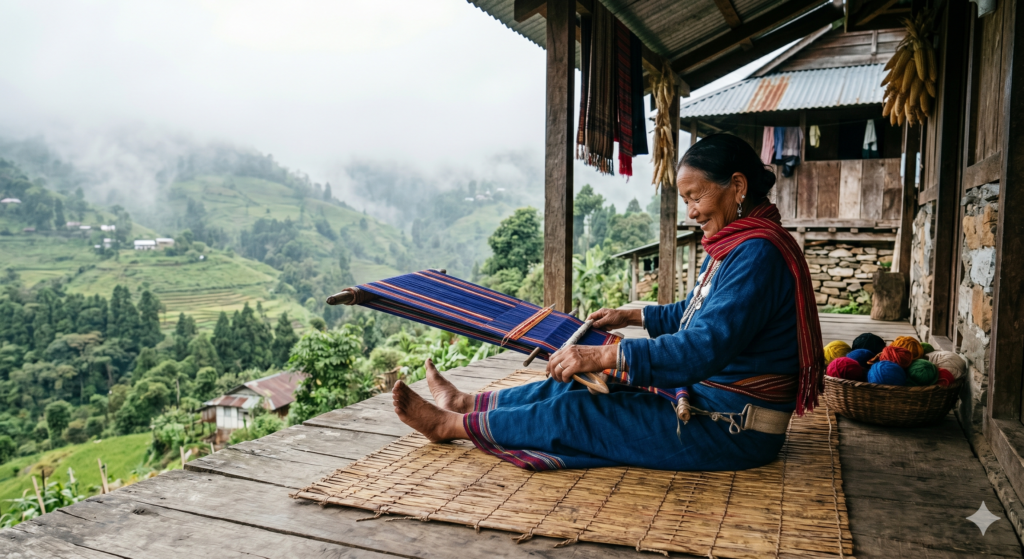
Much like the Loin Looms of Assam, the foundation of Lepcha weaving rests on the Backstrap Loom. In the native Lepcha language, this heritage loom is known as ‘Kee’.
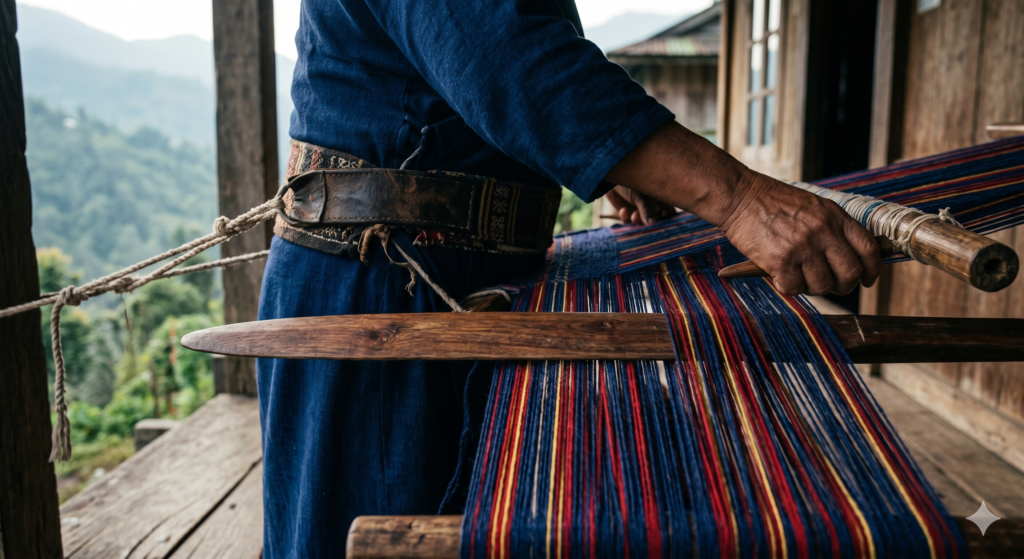
- The Mechanism: This loom operates without a permanent wooden framework or frame. The far end of the warp threads is tied firmly to a wall or a pillar, while the closer end is fastened around the weaver’s waist with a leather or fabric back-strap. As the weaver sits on the ground with outstretched legs and shifts her body weight slightly backward, the warp threads instantly tighten to create the tension needed for weaving.
- Weaving with Patience: There is no mechanical shuttle involved. Instead, bamboo rods and a flat wooden bar shaped like a sword (beater) are used to manually guide the weft threads one by one, beating them tightly into a remarkably dense weave.
2. The Source of Threads and the Heritage of Colors
In ancient times, the Lepchas did not practice cotton cultivation. Instead, they extracted fine, strong fibers from the bark of wild Himalayan giant nettle plants (locally known as Sishnu) to spin their yarn.
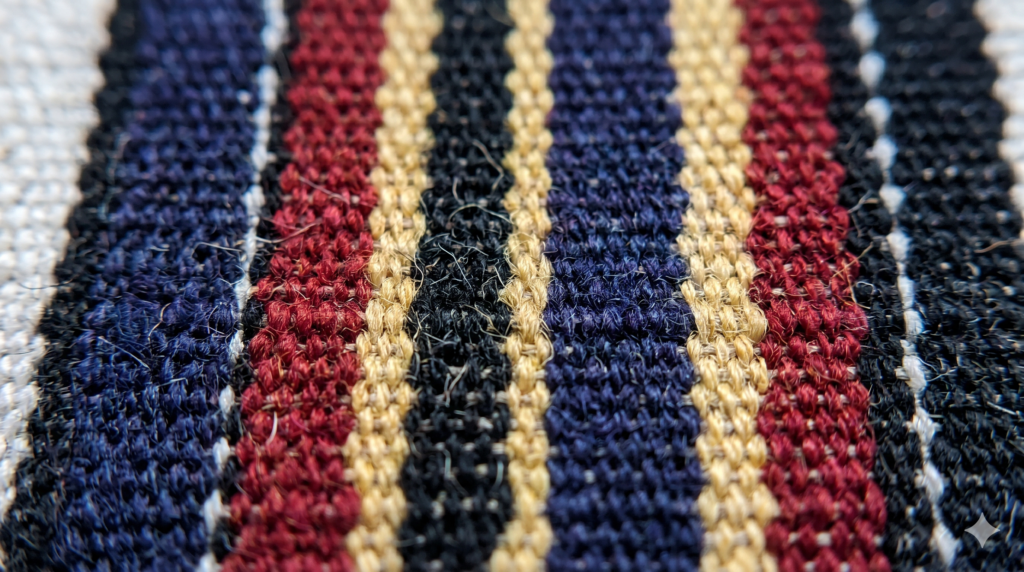
- The Color Palette: Lepcha weaves are instantly recognizable by their vivid, high-contrast color blocks. Traditionally, they weave with bold shades of deep indigo blue, bright red, yellow, white, and black.
- Natural Dyes: Originally, these colors were derived entirely from nature. Wild indigo leaves produced the blues, walnut hulls yielded rich dark browns, and raw turmeric root created the bright yellows. While cotton and wool have largely replaced nettle fibers today, the historic color layouts remain unchanged.
3. Characteristics of Lepcha Weaves: Vertical Stripes and Geometric Motifs
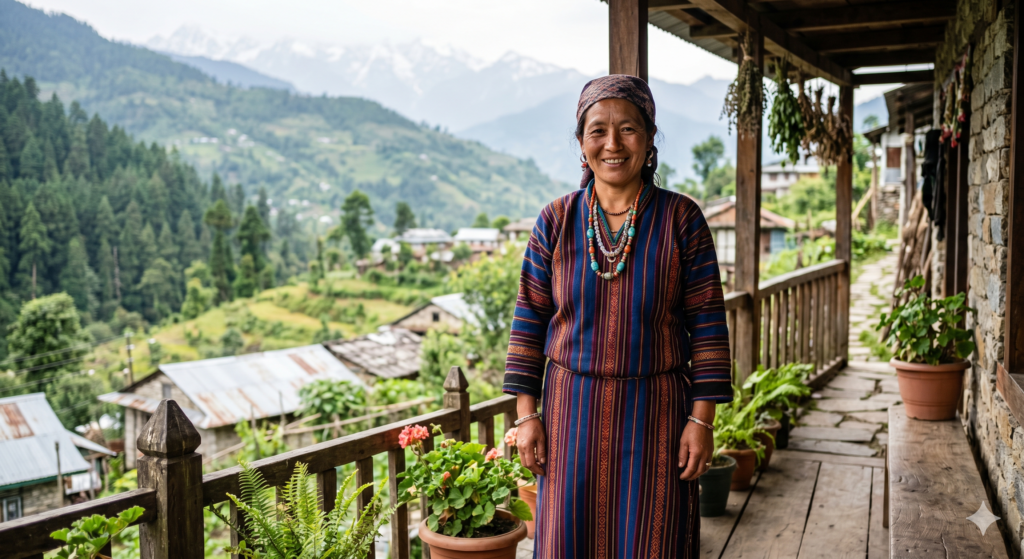
The visual hallmark of Lepcha cloth is its intricate arrangement of Vertical Stripes. Broad and narrow bands of contrasting colors are aligned side by side, creating a linear rhythm that beautifully mimics the ridges and valleys of the Himalayas.
- Traditional Attire: This heavy-duty fabric is used to tailor the traditional male attire called ‘Thokro-Dum’, a striped, cloak-like garment. Lepcha women wear the ‘Dum-Dum’ (or Dumdem), an elegant, wrapped dress. Due to its exceptional durability, this textile is also used to craft rugged shoulder bags (Jhora), mats, and winter shawls.
Conclusion
The traditional Lepcha weave of North Bengal is far more than a textile; it is a living archive of an ancient civilization surviving gracefully in the lap of the Himalayas. Defying modern challenges, the Lepcha women of Kalimpong and Darjeeling continue to preserve this priceless heritage. Vunavya remains steadfast in its mission to celebrate this magnificent artistry and present the raw beauty of mountain weaves to the global stage.